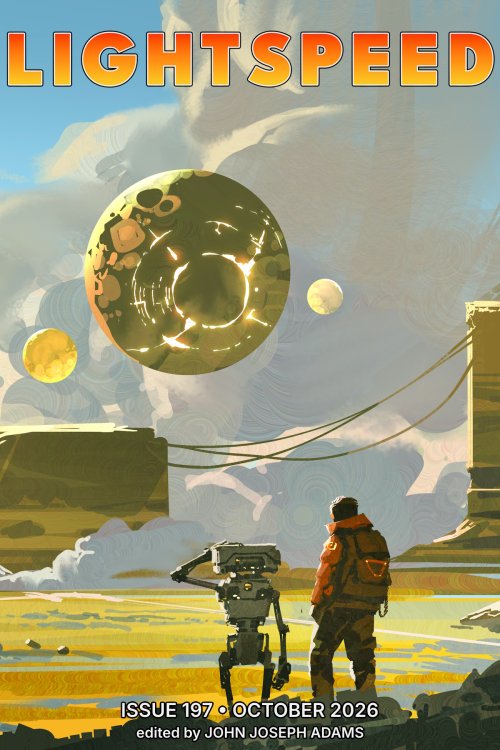
On the necropolis space station of the Tau Andromeda planetary system, the keepers of the tomb attended to the dead and the dying. They cleansed, prepared, and prayed over the bodies. They performed the last rites, paying intricate attention to the customs of each person’s native community. This was the most sacred of tasks. Carelessness or disrespect was not tolerated; just one mistake meant immediate dismissal.
The interstellar megacivilization of Tau Andromeda was built across five planets. Every day, millions of the dying and the recently dead were ferried on great funeral ships to the necropolis station. It was best if they arrived before drawing their last breath, but that was not always possible.
When a body was ready, the keepers of the tomb harvested their death echoes in glowing thuribles. The thurible breathed in the energy from the death echoes, until the core was saturated with pale blue light. The energy was channeled through a series of metal pipes, culminating in an immense vat at the center of the space station, which was in turn distributed to the energy grids of each of the five planets.
To the people of Tau Andromeda, the act of dying was no tragedy, but a gift given gladly in return for the pleasures of life. Their megacivilization lived in peace and plenty, fueled by the passing of those who came before.
But aeons passed, and no golden age stays golden forever. Civilizations rose and fell on the five planets of the Tau Andromeda system. There were schisms and wars and reunions. There was disease and disorganization. For a time, the rise of new religion saw the decline of the death echo harvests, with the old practice suddenly seen as archaic and heretical. Eventually, the population of Tau Andromeda dwindled and died out.
Now, the planets of Tau Andromeda are overgrown with wildlife, nature reclaiming the skyscrapers of a once-advanced megacivilization. The keepers of the tomb are long dead. The necropolis station hangs silent in space. The tombs remain, preserved eternally in the cold dark expanse.
• • • •
Millions of years after the golden age of Tau Andromeda, civilizations on three different planets are destroyed. Their deaths are almost instantaneous. One is swallowed by a gamma-ray burst. One annihilates itself with a weapon of mass destruction. One collapses under a swarm of matter-devouring nanobacteria, self-replicating at astonishing speeds: an undiscovered lifeform introduced to the planet by a small asteroid.
These three planets are in different galaxies, vast distances away from one another. Their civilizations have no concept of the others’ existence. It is a physical impossibility for anyone from any of these worlds to ever meet. But in their moment of destruction, their death echoes—that strange energy, only ever truly understood and measured by the keepers of the Tau Andromeda necropolis space station—ripples out across impossible distances. Their death echoes overlap and reverberate through space and through time.
• • • •
Earth, AD 2237. It is monsoon season on the Singapore Strait. The rain cascades in heavy sheets, drumbeat-loud against the metal platforms of the Singapore Floating Archipelago.
Esther sits on the top level of the watchtower. She sips a cup of watered-down kopi as she keeps a bored eye on the dashboard set up on her desk. She is supposedly monitoring for unauthorized foreign activity on the storm-tossed sea: motorized sampans that abandoned the Jakarta Megaship’s endless voyage around Indonesian waters, or submarines that drifted away from the Undersea Federation of Malaysia.
As usual, there is no unauthorized foreign activity to be found. She is increasingly aware that her job at the Department of Security is a defunct role, a symbolic gesture of the government’s protection. Nowadays, there are no pirates, no organized crime, no drug trade. There aren’t even any refugees. No one is fleeing from their homes in the hope of a better future, not anymore.
While wars rage across the rest of the world, the superpowers of east and west tearing each other apart over the remaining slices of habitable land, their forgotten corner of Southeast Asia is slipping quietly away into the rising ocean.
A cartoon envelope pops up at the bottom of the monitor, an old-fashioned symbol indicating that she has received a message. Esther sighs but clicks on it anyway. As expected, it’s from Wei Jie.
“can we talk? after work”
She replies: “maybe weekend,” and then mutes the interdepartmental chat.
She ended her relationship with Wei Jie last week. She doesn’t feel particularly sad about it, but Wei Jie seems to feel enough for both of them. He sobbed through the short, awkward conversation. “Is it because I keep nagging you about the baby permit? I’ll stop bringing it up, I promise. Maybe next year we can think about it.”
It’s not about the baby permit, although she was indeed baffled that he actually still wanted to reproduce, even with the last remnants of human civilization on the brink of extinction. It’s his obliviousness. It’s the fact that he genuinely believes there will be a next year, and a year after that. The fact that he works in the Department of Home Affairs but still somehow failed to notice that no one’s baby permit applications are getting approved anymore. That, if nothing else, is a clear signal that there are no future generations to plan for. Their only priority now is to make sure that the citizens who are currently alive can keep on living in decent conditions for as long as possible.
Once she began to feel the blunt edge of contempt, she knew the relationship was over.
Unfortunately, he can’t seem to accept what is blatantly obvious to her. What is the point of this obstinate refusal to accept the truth? He’s not the only one. There are so many people still valiantly planning for an impossible future, still willfully blind to the facts. Esther accepts the imminent end, lets the inevitability of it wash over her and through her. It’s okay. Sooner or later, everything returns to the sea.
She gazes out at the raging, empty ocean. She knows with a deep, self-satisfied certainty that she has nothing to complain about. Throughout history, billions of people led short, brutal lives and died unpleasant deaths. She, at least, has been privileged enough to live for thirty-five years, and although it’s mostly been a slog, she can’t deny it was interspersed with brief moments of happiness, maybe even love. She feels flatly contented.
• • • •
In the verdant meadows of the planet Autura, the Collective morphs into the Farmer. The Collective consists of trillions of tiny Units. The Units are miniscule insectoid creatures with shiny black exoskeletons. They swarm together in perfect unison into a rippling mass. As each Unit falls into their correct place to make up the Farmer’s body and brain, the neural patterns of the Farmer’s mind take shape. Impulses stutter into thought. The Farmer attains consciousness.
The Farmer walks across the meadow in a graceful, lumbering motion. Their many legs drag in long grooves through the dirt, tilling the soil in neat rows. As they walk, sacs in their underbelly excrete a nutritious fluid formed from the liquidized corpses of dead Units.
Of all the Collective’s Characters, the Farmer leads one of the most contented lives. Unlike the Philosopher, the Farmer does not agonize over the meaning of life as a Collective, the intricacies of personal identity, and the eternal question of whether a Character dies a new death every time the Collective dissolves to form someone else. Unlike the Leader, the Farmer does not worry about the future of the Collective, the direction of their civilization, and the possibility of unknown threats looming on the horizon. Unlike the Teacher, the Farmer does not bear the daunting responsibility of developing new Characters to meet the needs of the Collective’s evolving society.
The Farmer ploughs the land, plants the seeds, fertilizes them, and then harvests the milky-white fruit that provides nutrition to the Collective. The repetitive motion brings comfort and satisfaction. The Farmer is only formed during the planting season and the time of harvest, so their life is one of sunlight, warmth and plenty.
As a single cell in the neural network of the Farmer’s brain, Unit XJ7832 experiences comfort, satisfaction and warmth too—insofar as an individual Unit can consciously experience anything. Unit XJ7832 was born three revolutions ago in the rich bubbling swamp of the Mother’s Embrace. It emerged from the soup with millions of its siblings, instinct driving them to join the comfortably amorphous shape of the Mother, where they learn their places in each of the Collective’s Characters.
Surrounded by trillions of its siblings, all united in a single purpose, there is no need and no desire for individual thought. Unit XJ7832 plays its part, and together, the Collective moves forward.
• • • •
Constant storms rage on the gas giant planet of Lalesh. Winds blow at supersonic speeds across the surface of the planet.
The Wisps of Lalesh do not have names; their unique patterns of movement as they hurtle along the air currents are identification enough. Made of thin, weblike tissue that catches the powerful wind like sails, they ride the storms on an eternal journey around the planet.
If an alien ever visited Lalesh to admire the beauty of the raging storms, they might be forgiven for failing to realize that the fluttering slips dancing on the winds are alive at all. The Wisps do not appear to move autonomously. They do not need to eat, because their weblike skin absorbs all the energy they need from the movement of the storm itself.
But the Wisps are not just alive; they are vibrantly, intellectually, colorfully alive. As they fly through the wind, they ruminate on the philosophies of the universe. They solve complex calculations. They compose poems of epic scope. All this is communicated via an intricate language of rippling movement.
Depending on the thickness, composition and surface area of their fluttering bodies, the Wisps traverse the winds at different speeds. This divides them into separate flocks. A flock flies at the same speed in the same trajectory, and all the while they tell stories and sing symphonies and marvel at the luminescence of each other’s minds. Your new theorem, revolutionary! This verse of your poem, it redefines literature!
One Wisp, however, does not fly with a flock. Their body has an awkward shred down the middle, making their flight path lurching and inconsistent. The Lonely Wisp passes through flocks on occasion, but try as they might, they can never stay with the group. They either lag behind or hurtle helplessly ahead.
The Wisps are not meant to be alone; they are artists, poets, scientists, and scholars. The wonders of their minds are meant to be shared, admired, exalted over. But the Lonely Wisp dances through the storms on a solitary path, creating beautiful things that no one else will ever see.
• • • •
The death echoes of the three planets ripple across vast distances from the point of destruction. The waves of energy meet mid-space and pass through each other with a discordant buzz. Energy sparks and jumps, stuttering through time.
In the final days of Earth, Autura, and Lalesh, their people become subliminally aware of something alien, something unfamiliar, pressing in at the periphery of their subconscious; experiences so wildly different from their understanding of existence that their waking minds cannot make sense of it.
When they sleep, they dream strange dreams.
• • • •
Esther has been buried alive. All around her is pitch blackness, but not the silent, still darkness of her quarters at night. This darkness is alive, writhing, and skittering. She is buried in a sea of bugs. She wants to scream and struggle—but she can’t. Because she’s one of them. She has become a small scuttling thing herself amid a massive throng of small scuttling things.
Horror swells in her, but there is no release. She can’t make a sound. She can’t move against the writhing mass of insects pressing against her. She is trapped.
With nowhere else to go, she retreats within herself, desperately trying to block out the nightmare unfolding around her. Gradually she becomes aware of something else, something beyond the horrible scuttling movement, beyond the trillions of exoskeletal bodies and insectoid legs. She begins to feel a pattern to the movement. Unbelievably, there is a semblance of order here amid the chaos.
She gives in to it. What else can she do? She moves in the pattern that she is called to move in, lets it pull her along, and soon she realizes that her body knows what to do, even if her conscious mind does not. She swims along the flowing current of bugs, and although they move together, each one has its own distinct role to play.
As she moves through the tides of Units, her perspective begins to shift. There is a broadening, a zooming-out, like staring at an optical illusion and suddenly seeing the big picture.
And it dawns on her—
She is just one cell among trillions in this massive organism. She is no better than any of the others. She is no smarter, no more jaded, no less ignorant. They are all the same, and individually they are insignificant, insentient. But together, they are a thinking thing, with a mind—a consciousness—a soul.
She jolts awake, gasping. Tears stream down her face. She rolls off her bunk bed and staggers to the small mirror hanging on the wall. Her reflection is almost unrecognizable; she shrinks back from her bloodshot eyes, her pale skin, her expression twisted in confusion and fear.
She can’t remember the last time she cried. For so long, everything has felt so muted, so meaningless; her emotions like a stagnant pool, stirred by neither joy nor despair. But now she remembers the terror of that writhing place, buried alive in the swarm of their bodies. And the wonder of it, the beauty of their synchronized movement, working together to form a seamless whole, a person.
Someone pounds loudly on the door. She staggers the few steps over to it, unlatches the lock with trembling fingers, and pulls it open. Standing there, one fist still raised to knock, is Wei Jie.
“What happened?” he demands. He lives in the room across the corridor. It was the compromise they landed on, back when he wanted them to move into married-couple housing but she was reluctant to give up her comfortable solo quarters. She beat astronomical odds to win the ballot for this room, while most of the other singles slept in double-decker beds down in the dormitories. It just pained her too much to give up that privilege, even for love. “I heard you screaming all the way in my room. You okay?”
Esther runs a hand over her sweat-slick face. “Just a nightmare.”
Wei Jie looks skeptical. “Since when do you get nightmares?”
He used to describe his dreams to her when they met for breakfast. Esther actually quite enjoyed hearing about his dreams; they were weird and creepy, absurd and funny. She, on the other hand, never had anything interesting to report. “I dreamed I failed my exam,” or, “I dreamed my boss scolded me.”
For a moment, she thinks about their dull mornings together, reading news pamphlets over diluted cups of kopi brewed from reused grounds, and she feels a stab of something horribly like longing. She looks at Wei Jie and wonders—is she justified in her contempt? Does she have the right to judge him? Aren’t they all essentially the same small scurrying creatures, living their brief lives and following the roles set out for them?
She has not asked such questions of herself in a long time. It is uncomfortable.
“I had a weird dream too,” he adds. “But it was a nice one. I was flying. It was cold, but I didn’t feel cold. All around me was this superstrong wind. There were weird flapping animals in the wind with me. Somehow I could understand them. One of them told me this amazing story. Wish I could remember it. Ten times better than the old Chinese dramas they screen in the rec room.”
“That sounds nice,” Esther says, surprised to hear the unfamiliar note of wistfulness in her own voice. “I wish I dreamed that instead.”
“Maybe you will tomorrow night,” he replies. He smiles at her, a little nervously.
Esther can’t help it; she smiles back. Wei Jie looks startled, and then his smile broadens. They both stand there for a few awkward seconds, smiling foolishly, before she mumbles some excuse and ducks back into her room.
• • • •
Unit XJ7832 has no concept of itself as an individual. It does not think, or feel, or experience anything beyond the Collective.
But there was a brief time, early in its life, when it did think of itself as a discrete entity. It was right after it matured from larvae in the swamp of the Mother’s Embrace. After it crawled out of the clutch of slimy eggs where it had grown to adulthood, Unit XJ7832 stood on the muddy shores of the Embrace, and for a brief time it was simply itself. It gazed upon the amber sky and the glowing sun setting over the bubbling swampland. It saw the landscape of its homeworld through its own eyes, not the eyes of the Collective.
All around it, its siblings were taking flight. Unit XJ7832 recognized the call of its ancestors, the instinctive understanding passed down through generations. It parted its shell to reveal a pair of gossamer wings and buzzed into the air, joining the thick swarm of Units.
Hovering in the air was the massive amorphous form of the Mother, waiting for them, exuding gentle benevolence. The newborn Units flew into the Mother and became the Mother themselves.
Unit XJ7832 reached the Mother and was absorbed into them. As the mass of Units closed in around it, that warm sensation of comfort and belonging was the last thing that Unit XJ7832 experienced as itself. After that, there has only been the Collective.
Until now.
Now, Unit XJ7832 is not with the Collective. It is somewhere else. And it is alone.
Unit XJ7832 shivers on the bed, pulling the thin blanket around itself. Where are its siblings? It longs for the Collective. It looks down at itself, horrified and entranced by its strange, long, pale, soft body. It stands up and looks down at its hands. Strange hands, weak and inefficient, unlike the powerful appendages of the Warrior or the agile many-jointed fingers of the Craftsman.
These thoughts . . . These feelings . . . They are not coming from the Collective. They do not originate from neurological pathways made from trillions of Units. They originate from . . .
From itself.
Unit XJ7832 does not allow itself to dwell on this vast impossibility, this warped new reality. Instead, it flexes its hands, focusing on that instead. The appendages are so solid. The skin is smooth. It is one thing, not an amalgamation of trillions. How alien.
Instinct propels Unit XJ7832 towards the door of the small room. It opens it and steps into the corridor outside. There are neither doors nor rooms on Autura, but somehow it understands these foreign things intuitively.
Unit XJ7832 walks along the corridor, glancing up at the flickering fluorescent lights. Other Characters walk past it, sometimes muttering a quick greeting.
This is a startling sight. Unit XJ7832 has never witnessed a Character from the outside. The Collective is only large and complex enough to form one Character at a time. The Collective is a massive, interconnected family, but every Character is completely alone.
It must be a lonely existence.
Unit XJ7832 barely understands the thought that flits across its fledgling consciousness. These are strange, unfamiliar, alien concepts. It is half itself, half something else.
It walks down the corridor, pushes open a door, and steps out into the balmy night air. The residential quarters are on a floating metal platform in the middle of the ocean. Unit XJ7832 gazes around at the vast expanse of dark, rippling water. The night sky above is dusted with constellations of stars.
It crouches down beneath the railing that separates the edge of the platform from the sea, and realizes that it wants. It wants to jump into the ocean. It wants to feel the cool water against its skin. It wants to taste the salt.
It reaches down, fingers brushing the rippling surface of the water—
—Unit XJ7832 awakens in the Collective. Its allocated hours of rest and replenishment are over. It is time to return to its tasks. Other Units will move into the replenishment area for their turn to rest, and Unit XJ7832 must take their place.
Is being part of the Collective a kind of death?
That sudden, inexplicable question hovers just beyond Unit XJ7832’s capacity for understanding. For a moment it almost thinks, almost feels. Then it rejoins the seamless flow of Units, falling back into its proper place, and forgets itself amid the warm embrace of the Collective.
• • • •
There is no wind.
The Lonely Wisp can hardly grasp the concept of life without wind. Lalesh is a world of air; the Wisps are creatures of flight. But here in this strange place, the Lonely Wisp stands on solid ground.
They are standing in a field of orange grass, swaying gently in the breeze. Above them, the amber sky is streaked with pale green clouds. The field is studded with delicately twisting crystalline sculptures, shimmering in the sunlight, reaching skyward with its translucent tendrils.
The Lonely Wisp looks down at themself. Their body is made of a swarm of tiny creatures. As they take a step forward, their body ripples, trillions of Units moving in a synchronized wave. The Lonely Wisp raises hundreds of many-fingered hands and gazes at them, through eyes that are also made of insectoid Units.
Together, they are the Artist.
The Artist’s many hands move in a blur as they shape the crystal structures, carving intricate designs, twisting and pulling the crystalline material with powerful many-jointed fingers. As the sculptures grow taller, the Artist grows with it, the swarm of Units thinning out and stretching upwards to accommodate the sculptures’ height.
The amber sun meanders across the sky. Eventually the shadows grow long, and the sky darkens. The Lonely Wisp gazes out at the crystalline structures, twisting artfully skyward. As the sun sets, the sky turns rich hues of red, gold and pink. The colors are reflected in the sculptures’ shimmering translucency.
There is no-one else here to witness the beauty of what they have created, but in time, there will be. Eventually, other Characters will walk this field and look upon the sculptures. For as long as the Collective lives, these sculptures will stand: the embodiment of the Artist’s luminous mind.
The rushing wind around her is inconceivably cold, just a few degrees above absolute zero. It is delicious. She is a creature of the frigid air, almost weightless. Her insubstantial body flaps in an uncontrolled dance. She wants to laugh, to howl her joy in a chorus alongside the howling wind all around her, but she cannot make a sound. All she can do is spin wildly, buoyed by the supersonic wind.
She has never believed in any kind of afterlife. It seems too much like wishful thinking—to believe that they are so important that they deserve immortality in any form, that their death is just too great a loss for the universe to endure. But maybe she is wrong. Maybe this is heaven. Maybe it’s this, only this, for eternity.
Please, she begs, let me stay here. Let me be this forever.
• • • •
Esther jolts awake to the discordant blaring of an alarm.
She stumbles towards the door and pushes it open, not caring that she is dressed only in a long t-shirt. The corridor outside is packed with people, pushing and chattering in panic.
Through the crowd, a hand reaches out and grabs hers.
“Wei Jie,” she gasps. “What’s happening?”
“It’s the end,” he says, and she is struck by how perfectly calm he looks, how serene. “Some country has set off a doomsday weapon.”
She gapes. She has heard the rumors, of course, that each of the global superpowers are developing weapons of such massive destructive potential that a single blast can destroy what’s left of human civilization. Deep down, she has never believed it. It is too absurd to pour resources and energy into developing a doomsday weapon when humanity is already shambling towards the quiet whisper of an ending. Let it end, she thinks despairingly, let the candle flicker and die. Give us that, at least.
But they don’t even get the luxury of a quiet death. Instead, they will meet their end in fire and pain—all of humanity, united at last.
A monotonous voice announces over the intercom system, “Report in a calm and orderly manner to your assigned bomb shelters. Do not stop to assist others.”
Wei Jie’s hand tightens around hers as he pulls her into a corner. “I don’t want to go with them,” he says. “Will you come with me?”
“What? But the bomb—”
“It doesn’t matter,” he says. “You know that. The bomb shelters won’t keep anyone safe. I don’t want to die down there in the dark, packed like sardines. Let’s go outside.”
She gazes at him wonderingly. Where is his timidity, his placid adherence to the rules, his dedication to the status quo? Skinny and bespectacled, he looks just the same as he has for the last ten years, but she has the odd feeling that she is seeing someone entirely new.
“Okay,” she says.
They follow the jostling crowd, but as the others surge towards the staircases that will bring them to the undersea levels, Esther and Wei Jie slip away through an open door. They step out onto the gently bobbing platform, breathing in the briny scent of the ocean.
The sky is red. The horizon is aglow.
Esther lets out a sob, which climbs into a wail. She doesn’t want to die. The realization horrifies her. She thought she was ready; she was so sure she was ready. But her stoicism has failed her in the moment she needs it most. She howls with wild abandon and animalistic fury. There is a strange joy in it too, a release. Recognition, at last, that her death is something to grieve. It matters, doesn’t it? Her life. Her experiences. Her thoughts. Why has she never realized before, how much they all matter?
Wei Jie holds her tight as she screams and rages. His thin, wiry arms wind around her as she thrashes. “It’s okay,” he says. “It’s okay. It won’t hurt. It’ll be over so fast. We won’t feel a thing.”
“I was flying,” she says, muffled against his chest. “In my dream, just like the one you had. I was dancing in the cold wind.”
“I don’t think it was a normal dream,” Wei Jie says. “It was something else.”
“Yes. I know.”
“Maybe we’ll end up there, after this,” he says, ever optimistic. “Let’s meet again in the windy place. I’ll look for you there.”
Everything lights up in scarlet.
• • • •
A swarm of unknown nanobacteria is eating through Autura. Plants shrivel into dead crisps. The lakes dry up. Animals are decimated into shards of bone.
They have fought disease before, but this is something new. The Collective transforms into the Physician, but there is no time to investigate the cause or concoct a cure. The bacteria surge into the Collective. The Units die in the millions, tiny bodies falling to the ground.
The Physician staggers. They lift their hand, watching in horror as pieces of themself dissolve.
Unit XJ7832, part of the Physician’s eye, watches as everything falls apart. The Physician’s fear and loneliness ripples across the surviving Units. For a moment Unit XJ7832 feels afraid, not just as the Physician, but as itself. And then it feels nothing at all.
• • • •
The Lonely Wisp is composing a new poem as they soar on the wind. Lost in the ecstasy of creation, it almost doesn’t matter that it will never have an audience. Beauty for beauty’s own sake is the highest form of art.
They have no idea the gamma-ray burst is coming until it hits.
• • • •
The death echoes of the three planets crest out through space like a great shockwave, breaking over planets and stars and nebulae.
The waves of energy pass through the Tau Andromeda system, sweeping unnoticed over the five dead planets. But when it passes over the necropolis station, for a moment every empty thurible glows with energy. Firelight flickers in lamps on the necropolis walls. The gears of great clockwork machines groan into stiff movement. Stagnant fountains trickle and begin to flow.
For a moment, the necropolis space station lives.
Then, with a sigh, the death echoes fade. The once-great necropolis space station lies still and silent once again.
Enjoyed this story? Consider supporting us via one of the following methods: