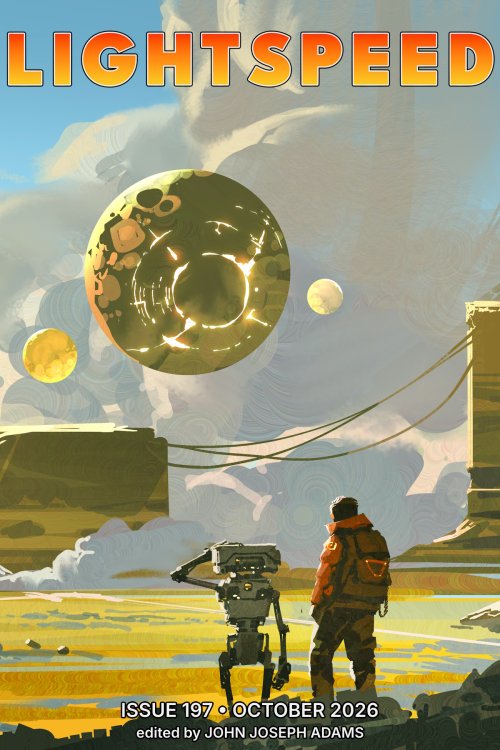
I beg you, let me tell you about my daughter. My brilliant daughter will be one of the four people who survive their airplane crashing into a giant. Or, more accurately, a giant swiping their airplane out of the sky. Perhaps it meant to catch, or caress. My daughter will never know. Usually airlines predict giants ahead of time, from sightings or seismic activity, but this one was not easily seen and quick as a whip, like my daughter.
The first survivor of the clever plane accident will go on to become an abusive father. The second survivor will die a few months later, a viral infection caught from the medical staff who treated her. The third survivor will suffer permanent spinal injury and be suggested euthanasia per the guidance of the Canadian government. And the fourth will be my daughter. My beautiful, brilliant daughter will survive with nary a scratch. She will unfold from the ruins of the crash-palm-viscera like a butterfly unseaming from the chrysalis. She will drag herself forward, covered in inhuman blood. But I will inspect her and see no injury. I cannot wait for her to be born.
• • • •
She will have an extremely difficult life, heralded by the circumstances of her extremely difficult birth: immaculate conception. When she becomes thirteen I will push her out of our home, forcing her narrow body to climb the tunnel up and out, into the precious, slumbering thunder. She will be crying very hard. I will tell her, go become fat out there. Become an adult so fat and tall and strong you can never slip in here again. I will shoulder her feet, her burn-welted soles. I tell her they will heal in the sun. It is not easy to rear a child. You must drag and push and pinch them into the circumstances they deserve.
On the flight she will be on her way to achieving great things—delivering a research talk at the largest conference in her field of giant studies. She will be marking her speech with a highlighter, intelligent strokes across the paper laid on the meal tray, muttering in that deep voice I immaculately conceived. Her frown lines will be deep, like wells to drink from. My beautiful daughter will reach her thirties—will you believe it? She will have moved mountains and felled forests to world renown—demonstrating how brilliant she is. She may even have a lover. When I was her age I was nothing. When I was her age I may as well have been a child with empty hands.
I cannot wait to become pregnant. And I hope she will come soon, as it is so dark in here, and the floor so muddy, and the wind rhythmic and wet.
• • • •
When I was a child I lived in a valley where planes never reached. I lived in a valley where giants were. There were two of them, in romance, or so I suspected, as the behavior of giants was hard to scry. They slept standing, cheek on the other’s shoulder. Towers of nightness. Breath rumbling for miles. Then gone, when day came. In the interstice I would sink into the wood and try to catch sparrows, slow and barehanded, until the wood fell silent. Then to hide in the closet; the ground shook as they neared. If you make a giant angry, or if it covets you, it will remove the scalp of your house, and you will disappear.
When I was pregnant I felt my stomach was a closet. I dreamed of all I might provide my child. I would not be distant and meager, like my mother, or angry, like my father. I would not be covetous of where my child’s life might lead; her life would be a testament to me. My parenthood would transcend my parents. I had escaped the valley.
But when my daughter was born I saw, briefly, a shock of light, placental. It frightened me. I was holding her and I put her down too quickly. She began to cry. I reached for her again.
• • • •
Her preteen years would be difficult. Mainly because she yearned for the tunnel. She spent most of her time at the very back of our perpetually damp home, during the long calm and the rare thunder both, her head tilted back, catching handfuls of that fresh wind with her nose. But when I forced her to go, she squirmed in my grip and sobbed and begged me for anything else. I could not tell her why she must go: That I had begun itching to banish the wind, because of her affinity for flight.
Though I cannot climb the tunnel myself, if I pace to the very back of my meager home and stand on my toes and crane my neck and tilt my head, I can catch a scent of the world, both past and future. I can split each word from my olfactory nerve. But there is no one to hear my words save me, and so I keep my mouth firmly closed. It will be a long while yet, before I consider the possibility of the wind carrying my voice. Even then I will not beg.
• • • •
The day my brilliant daughter boards the plane, she will start the morning waking next to her lover. Her snoring lover will be touching her arm, right where I gripped her to lift her into the tunnel. She will shake off her lover’s hand, grab her research papers in the kitchen, remove her earplugs, and board the plane.
• • • •
Some days I feel quite young. These are days I sit below the tunnel and let slivers of the wind touch my ear, my face. I will learn my daughter has taken up smoking. I will learn my daughter shames her lover with dramatics, such as choosing only to swim with her socks on. My nerves will tease out her favorite pastime, when she leaves the university to walk along the river, with all its stinking waste, and watch the dockworkers heave pallets from the bellies of ships, and sometimes she misses her train on purpose, sometimes two trains, and crouches on the curb, by a bench cut in two, eating falafel and shaking crumbs from the paper lining for the rats.
She studies in the city. In the city there are giants but they look very different: slender as ghosts, slipping between skyscrapers. Here then gone. Making no trouble at all. She asked her roommate once, in college: When you’re on the train do you ever wonder if the screeching wheels are actually giants, curled around the tracks? Do we know what giants sound like?
• • • •
I tilt back my head and scream into the wind: Oh daughter! Oh daughter!
• • • •
I have never met a mother and daughter who didn’t spark off each other, illuminating their surroundings. You will find in the cramped darkness it matters little if your child resembles you. Truth be told I was afraid of the light, of it dawning somehow and then seeing that through immaculate conception she held my same face. In the gristle and the gore of the palm and the plane, as both belch smoke into the sky, I will search her red face and with relief find I do not remember what I looked like when I was young.
• • • •
When the palm collides with the airplane, my daughter’s brilliant papers will fly off the tray. The inertia will yank her brilliant soul half-out her brilliant body. In the seat next to her, the line of the third survivor’s spine will become a map of a nightmare. The father who is not yet abusive will have his face screwed against the elements, studded with plastic and glass. And at home, her lover, head bowed over a laptop, will raise their head briefly. A prickle, like a fingernail tracing the backs of their ears: There’s something in the air.
Adjacent to the plane, the giant will not survive the encounter. Its throat will contort from the impact. Its arm will nearly sever at the elbow, and quickly, and silently, it will fall. But for a moment, its life. The feather light. Against its hand.
I have scented the plane, shattered in two. I will right myself and stumble to the tunnel, only to find it collapsed, smaller than a child’s door. To aid my steps I will grip the arms of an immaculate ghost, who once descended for conception. And in the predawn air, I smell it—the promise of a sparrow.
My brilliant daughter beholds the giant’s face. A face she’s seen only once before, on a night overwhelmed by snoring thunder. She unbuckles from her seat and falls to the ground.
Then, hand over hand, she will drag herself forward. Tear-smeared, chest heaving, to cut me from the stomach of the giant. I know she can, she must. I know she will.
Enjoyed this story? Consider supporting us via one of the following methods: