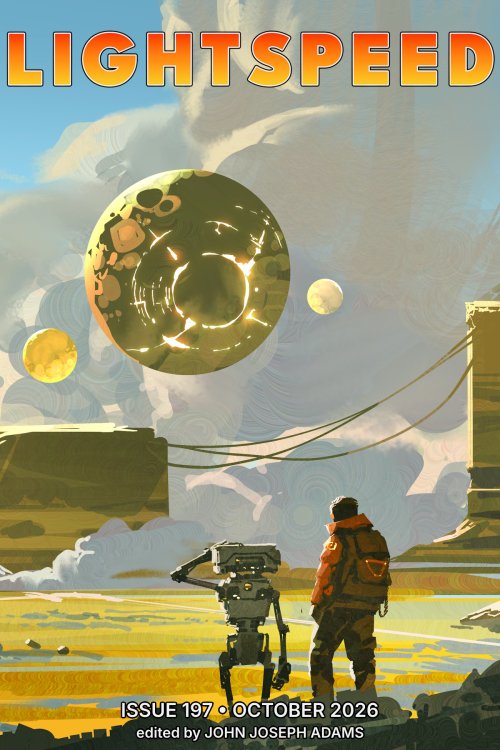
We’re so happy to have “Ice Like Honey” as one of the science fiction stories for this month. Can you tell us about what inspired you to write this story?
The timing was perfect. I have been a solarpunk for years. I was introduced to it at Readercon. A year later, I ran my own panel there on solarpunk and Afro-futurism (bit.ly/4cE3ymK) with Michael J. DeLuca, Tananarive Due, Cadwell Turnbull, followed by an essay on the subject for ReactorMag.com. No more than three months after I wrote an essay about solarpunk noir for Solarpunk Magazine, I received an invitation from Liz Gorinsky to join the Dartmouth Speculative Fiction Project.
Man, the Dartmouth project leads Solomon Diamond and Paula Olson along with the editors Liz and Sharang Biswas clearly did their due diligence because they paired me with Hélène Seroussi, the program lead professor of systems engineering who specializes in “Glaciology; ice sheet modeling and ice sheet contribution to sea level; ice-ocean interactions; climate science.”
Dr. Seroussi and I hit it off from the very start. Honestly, I wish she lived closer to New York City. She’d definitely be in the close family friends category by now (Hmm, I should give her a ring). The same day Hélène and I met, I knew exactly what I was going to write about. Her research into glacial modeling and ice sheet melt were instrumental to the story’s genesis. That, plus my religious binging of the Volts.wtf with David Roberts, a podcast focused on the technology, politics, and policy of decarbonization, were the backbone of “Ice Like Honey.”
From the first sentence to the last, this story drips with noir style—could you tell us about some of your favorite noir writers and stories?
Of all the “punks” or “SF” genres out there, solarpunk is the most functional and relevant. It’s the one we can plant seeds in right now and grow something anti-dystopian. But to do that, it needs to build itself some cultural capital. It needs to be popular. Noir is popular. Therefore, solarpunk noir. It’s not that far a stretch at all. The plot of the classic neo noir film Chinatown, for instance, starring Jack Nicholson, centered on attempts of the rich and powerful to steal control of water in Los Angeles for their own profit.
You asked about my favorite noir stories. I can say that the most influential stories (besides Chinatown) came from the anthologies of Akashic Books, their Brooklyn Noir and D.C. Noir, respectively. But much of the story was based on earlier research into first principles of the genre from essays by Fredric Jameson, Walter Benjamin, Lucas Hollister, and Sean Maher. The more I read, the more perfect the genre seemed to be for repurposing.
Noir narrative voice revels in the subconscious, contextualizing motivations and actions with deep meanings and implications for society, particularly with its use of violence. Noir description is atmospherically lush, ripe for contrast and juxtaposition. Furthermore, it has the capacity to draw the mind into the setting, foregrounding the background of competing ecosystems in the guts of the city, which often have their own dramatis personae.
Solarpunk noir takes a sideways step from neo noir (and cyberpunk for that matter) by starting with systemic agency. Noir and eco-climate fiction fall into the neoliberal logic trap where putting the ultimate onus on the individual to act runs into the impossibility of the individual to change outcomes for the better. The scale of the ecological problem combines with the broken noir lens for human nature.
Solarpunk noir rejects this and starts from a much more accurate understanding of our humanity. Solarpunk noir’s darkness would be the inevitable backlash of political violence from powers invested in our maladapted status quo. By focusing on the political element, i.e., systems of people in conflict over what is legitimate and what is criminalized, we take climate change, a phenomena that exists at a scale and complexity that most people find severely difficult to confront in their day to day lives, and put it in human terms with human limits, and most importantly for a good story, human passions. Doing so can return agency to us as individuals dreaming for a better future.
The use of second person point of view is incredibly effective in this piece. What inspired the POV choice?
Deploying second-person perspective as a narrative device was a deliberate choice in my larger solarpunk noir project. Though part of the Western canon since at least Homer, second person is generally considered experimental, even as it has grown in popularity since the ’80s and been used, at least in parts, in works as diverse as Chuck Palahniuk’s Fight Club and N.K. Jemisin’s trilogy, The Broken Earth. These authors’ use of the second-person narrative gives the impression of nowness, as if the story were being cocreated with the reader, simultaneously addressing them directly and giving the narrative a special driving force. But beyond the narratological effect, there are underlying thematic reasons for use of the second-person perspective in solarpunk noir.
Second-person stories call for an active reader. The reader must constantly negotiate personal identity with the addressee as used in the story. The second-person pronoun’s ambiguity (in English) invites the reader into dialogue at different rhetorical levels. By default, solarpunk noir has an intertextual relationship with previous noir-influenced media. Second-person has become a post-modern tool in support of radical personal change and an appropriate mode for reevaluating the past, a necessary step to imagine futures without forcing a complete break with history. It is engaging with the past even as it speaks to our immediate future (Iliopoulou) and that is quintessentially solarpunk.
Music acts as the backbone for this story. What role do you believe music plays in community and identity building, particularly for those in adverse circumstances?
There is that saying, right, “Winners write the history, losers write the songs.” I think that’s attributed to Frank Hart? Lots of cases for that. Certainly that’s the case for American music; the blues, then jazz (Alice Coltrane’s “Journey In Satchidananda” is often on repeat when I write), hip-hop, the beat goes on and on. And Black culture is synonymous with the city, and the noir finds its home where we are, whether we want it to or not. (bit.ly/4gZxwTH)
In this case, what really hit me was the sounds out of Detroit.
I don’t remember how I came across Drexciya the first time. I don’t remember what I was looking for. Actually, it was probably Clipping’s album The Deep. But for those who don’t know (I certainly didn’t) Drexciya was a foundational electro music group making (among other things) eco-critical, Afrocentric music in the 1960s. A lot of their music was built around the myth of an underwater country populated by the unborn children of pregnant African women. The ones thrown off of slave ships. Their children born to the ocean breathed water and became a maroon nation. I won’t say much more about that except their music was an inspiration and structural touchstone to “Ice Like Honey.”
Is there a project you are currently working on? And if not are there any themes, objects, or news that might be tickling your fingers?
I’m working on literally too much. Workshops and book festivals to promote my novel Daydreamer (boys with dyslexia, doppelgangers, and dragons). Among a bunch of appearances, I’m hosting a mini-comic convention in Brooklyn, October 17th called We Demand Comics. As far as my writing, I got some fun stuff coming up that I’m actually not allowed to talk about yet, and a manuscript about a West African princess, hoodoo gunslinger and (checks notes) a dragon. Too much fun!
a:5:{s:5:"width";i:339;s:6:"height";i:261;s:4:"file";s:25:"2017/02/Michelle-West.jpg";s:5:"sizes";a:4:{s:9:"thumbnail";a:4:{s:4:"file";s:25:"Michelle-West-150x150.jpg";s:5:"width";i:150;s:6:"height";i:150;s:9:"mime-type";s:10:"image/jpeg";}s:6:"medium";a:4:{s:4:"file";s:25:"Michelle-West-300x231.jpg";s:5:"width";i:300;s:6:"height";i:231;s:9:"mime-type";s:10:"image/jpeg";}s:14:"post-thumbnail";a:4:{s:4:"file";s:25:"Michelle-West-208x160.jpg";s:5:"width";i:208;s:6:"height";i:160;s:9:"mime-type";s:10:"image/jpeg";}s:12:"three_column";a:4:{s:4:"file";s:25:"Michelle-West-220x169.jpg";s:5:"width";i:220;s:6:"height";i:169;s:9:"mime-type";s:10:"image/jpeg";}}s:10:"image_meta";a:12:{s:8:"aperture";s:1:"0";s:6:"credit";s:0:"";s:6:"camera";s:0:"";s:7:"caption";s:0:"";s:17:"created_timestamp";s:1:"0";s:9:"copyright";s:0:"";s:12:"focal_length";s:1:"0";s:3:"iso";s:1:"0";s:13:"shutter_speed";s:1:"0";s:5:"title";s:0:"";s:11:"orientation";s:1:"1";s:8:"keywords";a:0:{}}}