“Repentance in Blue” takes us through the fallout of an inexplicable event that forever changes the relationship between a mother and her son. Where did the inspiration for this story come from?
I had recently read Ilana Masad’s Lambda Award-winning novel, Beings, which is a semi-fictionalized account of the abduction of Betty and Barney Hill, intertwined with the account of an archivist uncovering a queer, historical romance. I adored the book and knew I had to write an alien abduction story!
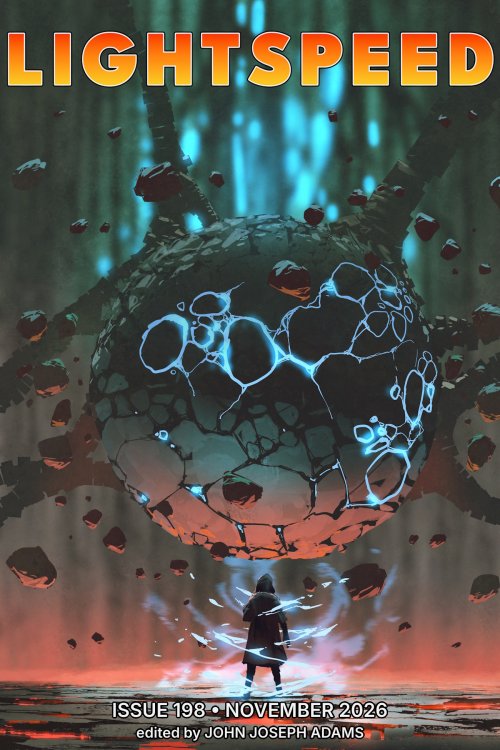
I loved your description of the shimmering, eellike entity within the light. What went into your choices in this scene?
Thank you! Hopefully the description gives an evocative little “taste” of what lies in the light; the reader can (and should!) populate the light with whatever they feel rings true for them, whether it’s a tentacled alien invader or just an accident of physics beheld by human sensory apparatus. Whatever you decide on: There is something there. And it is “real” insofar as it fundamentally changes the lives of these two characters.
Why do you think that people are drawn towards writing about encounters with extraterrestrial beings?
Are they still? UFO mania was so huge in the twentieth century, but I’m not so sure it has as much appeal these days in a world of incessant shock and 24-hour “content.” Even the recent reports on UAP’s (as they’re now referred to: Unidentified Aerial Phenomena) seem to have been met with a shrug before folks turn to the next insane headline. Maybe I’m speaking for myself, here, but there also seems to be a real disillusionment with the idea of space travel and exploration, and the possibility of finding life on other worlds. With public space programs being defunded and AI-obsessed billionaires churning through the resources of our own planet to create megalomaniac dream-fulfilment videoslop, why would we have any faith in such people to lead us off Earth? I think you see this somewhat reflected in contemporary publishing tastes, too: Science Fiction is a much smaller market than, say, Fantasy or Horror. With all that said, I do still hold a sense of curiosity and wonder when it comes to the numinous, and will always feel drawn to exploring that in my fiction. The moment we stop looking up at the stars with a sense of longing—and perhaps, even nostalgia—is the moment when the cages around our minds have definitively closed.
Like the characters in the story, we desire to know the truth of what happened but are left to speculate. What led you to this kind of ending?
I actually think the “truth” of the story is somewhat unambiguous—but how we get to that knowledge is a little unorthodox. I’m always trying to make my stories more nuanced, more sophisticated, more surprising, because, in the real world, people are nuanced, and encountering another (certainly difficult family members) can be fraught. Nonetheless: Where can we find moments of grace? Where can we reconnect? “Repentance in Blue” tries to hold many things together. Does mental illness exist? Of course. Is political extremism rampant? Absolutely. Do families break apart? Every day. Do aliens exist? . . . Possibly? Where does that leave us? All we can do is listen, and hold on to one another, as best we can.
What can your readers look forward to next?
I have a story out in the recent issue of Nightmare magazine, and a story forthcoming in Haven Spec in the near future. I’ve been working on a novel that I’m currently querying—and, in nonfiction work, I’m super excited about an article on Pokopia forthcoming in the LA Review of Books.
Enjoyed this article? Consider supporting us via one of the following methods: