The Mother
Ryan said he’d been seeing “blue” in his bedroom at night.
“Blue what?” I asked.
Light.
“Where?”
Everywhere.
Six-year-olds can be little fabulists, but he was inconsolable, so I took myself to bed with him the next evening, tucking him in as the sky darkened. His night-light flared, the shape of a plastic molded bird, lit from within like a phoenix. Amber, not blue. Not even close. The room eased into night. I heard my son’s gentle snoring next to me. I remember wanting to rest my eyes.
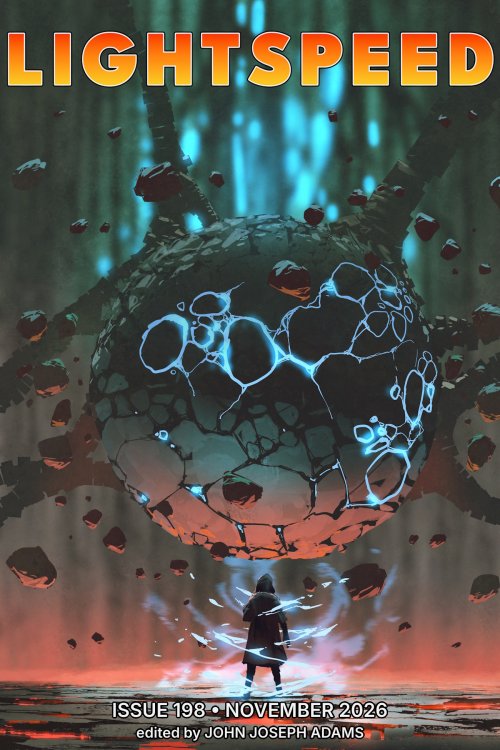
My eyes opened to illumination so bright it made the eye hollows of my skull throb. A copper taste filled my mouth, and all the hairs on my body raised in some animal presentation of fear. The entire room was filled with—yes—blue light, and heat, and sound: a bass, machinic purr that set my bones to tremor beneath my skin. I became horribly aware of the layers of my own body. Something darkened my vision and I saw—
Ryan. Laid out on his back in the air, hovering towards the window, sliding into that awful, living light—toward a shimmering figure that extended a three-fingered hand, each digit moving like a serpent. Another quality presented itself. There was texture to the light: a rippling bannerette of phosphorescence, a chromatic eellike spray flickering maddeningly behind the figure. I reached out for Ryan . . . felt my fingers close around his foot . . . but his body kept moving away, impelled, and my God! His legs were so stiff, so hard! And I couldn’t stop him. I couldn’t stop them taking my baby. My sweet boy.
The next thing I remember was a stitch of agony traveling whip-quick down my knuckles and wrists and elbows and shoulders, and a dreaded stabbing sensation in the chest that all women of my age fear the most. A current traced the junctures of my skeletal structure, adding its electricity to my own. I was felled by this current that was also running through Ryan (those fuckers!) and I passed out on the bed. My husband woke me, maybe a minute later, maybe hours, and I was screaming he said, screaming in my sleep, “They took our son! They took our son!” I kept screaming for Ryan—but there was no illumination now except that cozy glowing night-light, and my husband was standing over me, explaining that I’d had a nightmare, gently turning my head to see.
But when I tell you that the child I woke up to, rubbing his eyes, wearing a suit of Ryan’s body and pretending at sleepiness, was not my son, you can sure as hell believe it.
• • • •
Everything changed after that night.
“Ryan” still seemed like Ryan to everyone else: the happy kid, the confident kid, the kid who could make grown adults laugh with his goofy wit. But the dogs began to avoid him. He suddenly swore off eating oddly specific foods: no red meat, no fish, nothing green. I would catch him looking at me with a strange, squinting expression I’d never seen before when he thought I wasn’t paying attention. Like he knew I knew. When you’re a parent—when you’re a mother—you sense the first signs of trouble in your children.
I tried to talk to him at bedtime a month or so later.
“Ryan, honey, where did you go the other night? In the blue light?”
The term of endearment fell like poison from my lips, but I had to pretend. Maybe a sham of normalcy would embolden him.
I don’t know what you mean, mommy.
“Who was the person in the blue light? Did they do anything to you?”
I’m tired, mommy.
“What have you done with my son, you conniving fucking monster?”
The boy cried and cried until my husband came and wrestled me out of the room.
• • • •
He avoided me as he grew into a teenager, barely saying a word, flinching if I even so much as moved my arm too close to him when I was serving dinner. He hung out with my husband mostly, going to martial arts lessons and bike rides and gym sessions while I stayed at home, cooking for them, cleaning. We never made eye contact. He barely said a word to me, flinching if I even so much as moved my arm too near him when I was serving food.
He didn’t even say “thank you” to me for taping up every gap in the floorboards, every windowpane edge, every seam of tile and lip of floorboard in his bedroom to stop that awful light from coming in again. And it never did. Another betrayal: My husband would periodically remove the tape, and we’d get into the most ferocious fights while Ryan looked on, barely disguising his smirk, his eyes wide open for this.
“You might need to get some help, Mary,” my husband said to me after one of these blowups, massaging my hand with mindless, circular gestures. “You’re not well.”
“You didn’t see what I saw,” I said. My tongue was a coal in my mouth. “That’s not our Ryan.”
One day, a few weeks before he left for college, I begged him to come with me to a hypnotist I saw recommended on the internet; to my genuine shock, he agreed. Maybe I had worn him down all these years. Maybe he was done playing pretend after so long.
In that severe German woman’s office, he reclined on a couch while she sat behind his head and murmured into his ear, just murmured and murmured, I couldn’t hear what, and he looked asleep, but she said he wasn’t asleep, it was akin to being asleep but not quite, and she asked him, loud for my benefit:
“What did you see on that night when your momma stayed in your room to see the blue light?”
He was silent, for so long. The hypnotist kept murmuring. Then his arms and legs began to tremble—a little at first, then more violently, like something was shaking him—and he spoke words in no language I’d ever heard, and he choked, and even the German woman was unnerved and rang a chime to wake him, and when that didn’t work she took a glass of water from her desk and emptied it on his face. He woke, spluttering, sitting up and fixing me—why me, why am I always in the line of sight?—with a stare of hate I’ll never forget.
He left for college, flying across the country to New York City, and that was the last time I ever saw him.
After that, and even without his physical body, I buried Ryan—the real Ryan—in my heart. I imagined him flying in the upper air, faster than any aircraft or swallow or zephyr. Uncatchable. Free.
The Son
Trauma. Abuse. Words laid at my feet like offerings by friends, lovers, therapists in my adulthood. Your mother was probably an undiagnosed paranoid schizophrenic. A right-wing conspiracy theorist nutjob. You are carrying that trauma. You are a victim of abuse.
It was easier to agree with them even though, to me, “trauma” was something experienced by, say, combat veterans who had seen their comrades’ limbs blown off by a landmine, or the sole survivor of a car accident that had killed all of their living relatives. I felt healed: the narrative of my life explained, situated in a context in which the usual and the extreme were delineated, and evident.
I was about fifty when I stopped visibly aging.
I was sixty when people began to ask questions.
When I turned seventy, people grew alarmed.
At some point everyone I knew died.
Had my mother been right? Was she sick? Had I been taken? Laid out in an alien laboratory, each skin cell removed with a shining apparatus and replaced with new and unfamiliar motes, rebuilt like the ship of Theseus . . .
Maybe truth is a chimera of all of these things.
I don’t know why I have been blessed with such long life, but I do know that there is a purpose to it that I have to find for myself.
Certainly things seem different after so long alive. The world appears dimmer to me these days. More violet, really, or a dun blue: the color on the edge of an eclipse, crawling towards the end of the visible light spectrum. Perhaps that is where I am. Within frequencies, drawn-out, somehow. Abstracted. For how long, I couldn’t tell you.
Today is the 8th of June, 2220—one hundred and fifty years after my mother’s death—and I have come to put cornflowers on her grave, and a note.
Mom,
I’m sorry.
Whatever I am, I remain always,
Your son,
Ryan x
Enjoyed this story? Consider supporting us via one of the following methods: