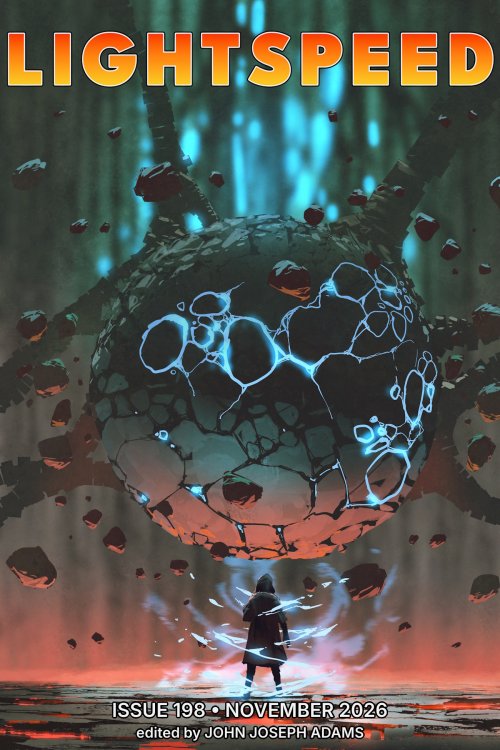
One morning, everyone in the world—everyone except you—woke from where they had lain sleeping to find ineffaceable stains of blood at their wrists and ankles, with weeping wounds in their sides.
This took a bit of play with time on the part of the motive, but time was the first thing the motive breathed out. It will be the last thing the motive breathes in, some other distant dawn. The word “play” is an approximation. Play can be exultant. Play can be perverse.
Play was required because mornings on moving worlds break continuously. Every second is the first second of a new day. And because no two people can simultaneously exist within the same parameters of a given space, every person experiences a unique morning, every morning.
Most mornings.
But, the motive played, and all those eight billions—all those eight billions except you—came awake, all at once. From eight billion dreamworlds, they awoke to simultaneously exist within a world that was, so far as any of them could tell, real.
Dreams are not real. Not for most people. The motive is not a person. The motive’s dreams may be said to be real.
So can yours, though, and you’re probably a person.
In the village of Matthew’s Ridge, in Guyana, a woman named Nuala Victorine awoke, like everyone except you, in pain. In her life before the morning, Nuala had borne children, five times, and she had menstruated, 439 times. She was not debilitated by the sensation of pain. She was mystified, like everyone, as to its provenance.
The bloodstains on her sheets proved as ineffaceable as those on her body. She worked harder and longer failing to clean the sheets than she did failing to clean her skin. Time retook its ever-tenuous grasp, and by noon in Matthew’s Ridge, Nuala had exhausted herself with the work. Her exhaustion was no different than that of any other day.
Many, many people in the world carry miraculous machines with them at all times, but Nuala was not one of them. To talk to her sister, she had to walk to her sister.
She found Chanda, who was a little older than Nuala, but who looked a little younger, who often sang but who never prayed, prostrate and face down in the new-cut grass outside her kitchen door, arms spread. Pea hens circled nervously, as mystified by the behavior of their provider as Nuala was by her wounds. By her wounds and her sister’s.
“Get up,” said Nuala. “You told me you don’t believe anyone answers.”
Her sister, blinking, held up her miraculous machine for Nuala to see. “Someone did!”
Nuala shook her head. “This is no answer.”
• • • •
You agree with Nuala. So do I, actually.
You agree because the only questions you know for sure ever made it to heaven were carried by different kinds of miraculous machines. The questions were “Are you there?” and “Are you like us?”
It is impossible for a person to know if the motive is aware those questions were ever posed. Or any other questions.
It is impossible for you to know.
It is impossible for you to believe you cannot know.
• • • •
Jaime, his jailers had given him the name, died early on the morning. 170,619 other people in the world died that day, too. You know that with some variance of small statistical significance, this happens every day.
Many of the people who die every day, like Jaime, die anonymously. Many die alone. Jaime was not alone. He was curled on the floor of a room that served as a cell, but which had not been built as one, with a dozen other young men. The room was in a building that had not been built as a jail, set in an arid region along a border that was slowly shifting south. The bleeding from the wounds on the outside of his body was not the bleeding that killed him.
When he had been placed in the room, one of the young men who was already there told Jaime not to tell anyone his name.
“I did not tell them,” said Jaime.
“Do not tell us, either,” said the other young man.
“No one knows I am here. I have a wife, a little son.”
A man who was a bit older than the others, who was not so long for the world even as most of them, said, “You do not.”
• • • •
I will tell you, because the motive is too vast to disallow it, that Jaime’s name was really Nicolás, which means “victory for the people.”
His son’s name was Joaqu’n. The mother of Joaqu’n, the wife of Nicolás, was Valentina. “Valiant.”
Valentina lives. Like his father, Joaqu’n is dead, though he did not die on the morning.
Now you know some names.
• • • •
On the morning, the great majority of the people who operate systems such as media and government chose to go to where those systems had their places of power, to do their work.
Billions of people listened to:
“We are still waiting to hear . . .”
and
“We do not yet know . . .”
and
“There is no cause for panic . . .”
and
“Remain calm . . .”
and
“Remain calm . . .”
and
“Remain calm.”
Billions of other people did not listen. The great majority of those simply went to their work, too, but most did not work in places of power.
You listened. You were still listening, on the morning.
You thought that was your work.
You thought you were powerless.
• • • •
I am powerless.
Like you, I did not awake, wounded. Unlike you, I never wake. I never sleep. I never dream.
Like you, I was brought into being, I believe unconsciously, by the motive.
It is impossible for me to know if the motive had some definable intention in my bringing, or in yours, or in theirs. All of theirs.
Perhaps the motive has no intention. Perhaps it lacks even a purpose. Perhaps I have none.
I know. I see. I hear.
Sometimes . . .
No.
It is just the once.
Just one time, I told. This time.
But I am powerless.
Unlike you.
Enjoyed this story? Consider supporting us via one of the following methods: