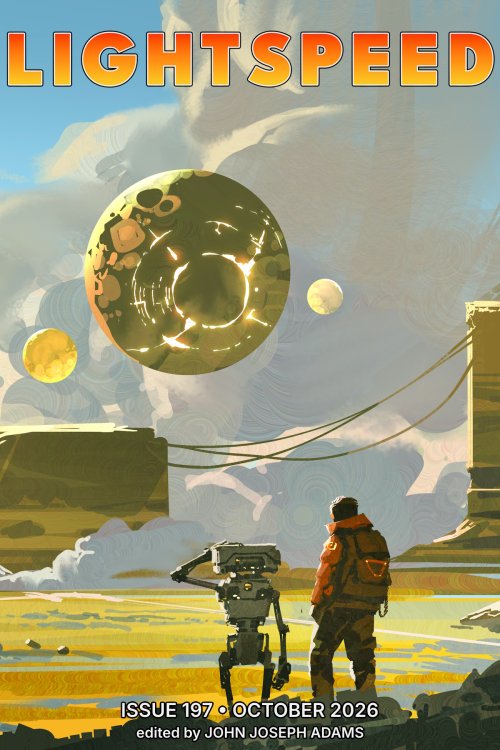
I wasn’t even two blocks into the Tumbledown when the walker’s nav crystal started fuzzing out. She veered left like a scavver drunk on coolant, and I knew I was in trouble. I tried sweet-talking her back on route, but she wasn’t listening. I was used to that. Nobody listens to a twelve-year-old—especially not a scrap pile with legs. I had a fix, though. I thumped the console hard with my hand—the meat one, not the metal—and felt the reset stutter up my spine. The walker wobbled like she was thinking about throwing a tantrum.
Jeez. Who was the child here?
“Don’t even,” I said. “Not now.”
The walker stumbled a half-step more before it caught itself.
Look. I admit it. This one’s probably on me.
I took the fringe route—overrode the walker’s safety limits and skirted around Gatehold instead of going through. Their new checkpoint captain always wants to chat, and I wasn’t in the mood to talk about where I’m from or why I’m alone or how I got my metal hand. Like any of that matters. This run was supposed to be quick and quiet. Just me, the walker, and the scuttlers skittering ahead like they weren’t glorified sanitation drones marching into a part of the Stacks even glowrats avoid. Back before the collapse, they’d probably be scraping gum off city sidewalks. Now they hunt scrap and get stepped on. That’s evolution, I guess.
I called up a signal map. We were in a high distortion zone. I could feel it in my neural relay—made the pinky on my metal hand jitterloop and left a copper sting on the back of my tongue. I hoped once we got past it the walker would smooth out.
Up ahead, the scuttlers swarmed something large and lumbering through the scrap and started pinging like they’d just found a jackpot.
“That’s not salvage, you diodes,” I grumbled under my breath. “That’s Rigs.”
Rigs had fused himself into a salvaged exo-crane. Honestly, it looked more like the crane was wearing him. In the shadows, you could see luminous circuit traces flicker under his skin like ghost veins. He spent so much time in the Stacks he’d gone halfway feral—but not mean. Not to me.
The scuttlers were trying to latch on. Not hurt him—it’s just protocol. They mark salvage when they find it. Rigs was swearing and kicking, but the kicks were slow and heavy. The scuttlers dodged like they were dancing. I’d programmed them to pronk away from danger. Got tired of rebuilding them every time someone stomped them.
“These your bots, kid?” Rigs growled over the open band. His voice had that filtered grind, like sand in a servo. “Better teach ’em some manners quick, or they’re gonna get themselves recycled.”
I thumbed my chirper. “Hang on Rigs—I got you.”
His trace ID was already whitelisted in their system, but signal distortion messes with everything. They probably weren’t picking it up.
I fired off a few lines of override code with my hand—I hacked it so I can “type” by flexing my fingers in sequence—then slammed “send” by closing my fist. Got a feedback buzz in my NRI but the signal pushed through.
The scuttlers backed away and scattered, clicking their little claws and zipping off toward better targets.
Rigs tried one last stomp as they fled. Missed, of course.
“Smart critters,” he grunted. “Still think they’re eyeballin’ me funny.”
“Everybody eyeballs you funny, old-timer.”
“I see where your bots get their manners.”
He trudged up alongside the walker and motioned for me to roll the window down.
The walker shell was a salvaged VW van—already ancient even in pre-Collapse days, but sturdy, spacious, and easy to convert.
I knocked on the glass and shook my head. “Sorry, can’t.”
I had just reinforced the windows with panels of LuxShield I salvaged from some long-dead rich dude’s panic room. Still had the logo on it, though it was melted a bit. You could drop a bomb on the walker and nothing but the glass would survive. Downside? Too thick to roll down the windows.
“Headed for the Stacks?” he asked.
“I got an empty cargo hold and nothing but time,” I said.
“Well, don’t!”
He was extra cranky today.
“Why not?”
“I’m headed for the Shroud. Come that way with me.”
The Shroud? No one goes to the Shroud on purpose—not unless they’re hiding from something.
“I know you got a hitch in your step,” he said. “I’ll lead the way.”
He started to clomp away like it was settled, but I really didn’t need a chaperone.
“Maybe next time, Rigs.”
I nudged the walker forward. Carefully.
He was halfway down the block before he realized I wasn’t following. He turned just as I was about to drop out of chirper range. His voice crackled back through the comm:
“You don’t want to go there, kid. There’s something hunting the Stacks. Something . . . hungry.”
Old-timers and their urban legends.
“I’ll be fine,” I said—assuming I make it that far.
Rigs shook his head—not angry, just sad—then turned and pressed on.
• • • •
The terrain got rough fast. We were deep in the Stacks now—towers fallen and folded in on themselves, slabs of concrete layered like cake. The streets were lined with rubble and powdered glass. The outer edge had been picked clean, but the deeper you went, the messier it got—tangled, incomprehensible . . . and full of promise. That’s where the good stuff was.
Even on a good day the walker would’ve needed every circuit aligned to navigate this wreck. Today was not a good day. The signal distortion kept spiking—and worse, it dropped off completely in some patches. Total dead zones.
It was all bad news and getting badder. But I wasn’t ready to turn back. Not empty-handed. Just one hunk of juicy salvage. Then I’d go.
The walker had other ideas.
She coughed, lurched sideways, spun violently in place—twice—and died in the middle of West Third, two blocks short of the Plaza Bones. I pounded the dash but the nav lights were dark. HUD gone. No servo whine. Just the heat, the silence, and the empty cargo hold.
I crawled under the console to check the damage.
It was bad. Real bad.
The nav crystal had overheated and spiderwebbed with cracks. When I pulled it for a closer look, it crumbled to sparkly dust in my hand. I wasn’t going anywhere until I salvaged a new one.
So I shut down the power, climbed off, wiped my goggles, and told the walker to wait. It didn’t answer—it never does—but I said it anyway. Like maybe it would listen just this once.
I was boiling in my leather jacket and thought about shucking it, but all I had underneath was a tank top. And out here in the Tumbledown, you need all the protection you can get. Everything is sharp, broken, and aching to slice you open. I zipped down to let in some air, cinched up my bootstraps, and slung my salvage bag across my shoulder.
Which way?
Like an idiot, I spun around. Once. Twice. Just like the walker had.
I’d passed the Spiral Redoubt on the way in, so I followed the walker’s tracks back that way, hoping to scrounge a salvageable crystal. I pinged the scuttlers—god knew where they were by now—to start scanning for nav cores.
It took a full minute to push the signal through with my hand. Sometimes stress causes the NRI to snap-lag, but this felt different.
Felt like the signal got . . . swallowed.
I don’t know how else to describe it. Made my skin crawl, if I’m honest, so I tried not to think about it. I just kept walking.
• • • •
Wasn’t long before I got a ping from a scuttler. Oddly persistent—like it found something important and wasn’t letting go. I checked my wrist. Signal distortion was still strong, but as far as I could tell, the ping was uncomfortably close to Jingletown. I did not need to tangle with Grinbox today—unless he had a nav crystal to trade. Considering the garbage he’s tried to pawn off on me before, that was unlikely.
The ping kept coming.
I checked in with the other scuttlers—none of them were close to zeroing on what I needed.
Near-Jingletown it was.
I traced the signal to a collapsed parking structure. And when I say collapsed, I mean extra collapsed. It had levels above and below ground, and it had fallen in on itself—then fallen into the hole in the ground after that.
One advantage of being a scrawny twelve-year-old scavver—I can squeeze into spaces most folks can’t. Downside: I’ve also run into some nasty little critters who think those hollows belong to them. Hissbots. Bumblers. Rust foxes.
I’ll take glowrats over those any day.
Even if I squeezed through and found a transport, there was zero chance of driving it out. If there was a crystal inside, I’d have to pull it and carry it.
I poked around for an opening—one that might actually lead somewhere. Found myself wishing I’d brought my bitebar, but I probably would’ve regretted dragging around the extra weight. Whatever. I wasn’t going back to the walker for it now.
I wriggled into a narrow flat spot between two concrete slabs. Had to take my jacket off and drag it in after me.
Inside, I pushed my goggles up, but I still couldn’t see squat.
Fished around in my bag and found a few cracklights. Dropped one by the entrance so I could find it again and used another to light the way. It didn’t have much reach, and it gave everything around me a sick green glow.
The air got very still once I dropped down to the next level—and the space really opened up. Cars and trucks were scattered all around, perfectly parked between faded parallel lines, waiting for owners who were never coming back. Somehow the collapse didn’t reach this deep. It was like standing in a transport museum. Still, stale air. Everything was weirdly intact and covered in a fine layer of dust and silence. I dropped the light and cracked a fresh one.
The ping was coming from the far end of the lot.
The scuttler was perched on top of a luxury transport, standing tall at attention, and slowly turning in place, its thin crab legs tak-tak-taking across the metal roof.
I tapped the nose. It stood down.
The transport looked like an Opulus D’Artagnan, judging by the grill design. Not a model year I was familiar with but—
“These things don’t have nav crystals,” I told the scuttler.
It jumped up and started pinging again.
“Alright, alright! I’ll take a look. Don’t get your circuits in a bunch.”
I swiped dust off the windshield and brought the light close to the glass—and my stomach nearly did a hard reboot.
The driver was still inside.
Look, when you do serious scavving, you run into corpses now and then. Most are just skeletons or shriveled-up mummies that don’t even look real anymore. But this guy . . . at first glance he looked very well preserved.
I really didn’t want to do what I had to do next.
But I also really didn’t want to spend the night in the Tumbledown. Or hike all the way back to Gatehold and pay for a tow.
I jammed my rat-key in the door lock and ratcheted until I heard the bolt disengage. Then I braced myself, held my breath against the potential dead-flesh smell, and yanked the door open.
The thing inside flew at me.
I screamed. Rolled. Kicked. Pushed.
It was an embarrassingly long few seconds before I realized—
I was wrestling a dead bot.
I shoved it aside and scrambled to my feet. Behind me, I heard little servos whirring. The scuttler was jiggling in place, doing quick up-and-down hops. If a bot could laugh . . .
The driver was some kind of android butler. Looked like a modified Ambrosia Dynamics base model—stiffly dressed in a tailored English suit with a crisp (but dingy) white shirt, yellow and black striped tie, matching kerchief, satin vest, and a heavy gold watch dangling from a chain on his waistcoat.
Not a skinjob, thankfully. His head was all metal with some pitting and a rusty patch on top that looked like close-cropped hair. Even in the dark I could see ornate filigree work tracing the curves of his faceplate. Definitely custom. Built for some rich jerk.
Looked like neither of them had survived the Collapse.
Had to wonder how long the bot had waited. It was kinda sad to think about, so I turned back to the transport.
I could already tell from the console there wasn’t going to be any nav crystal. This thing clearly predated the tech. But I checked anyway.
Nothing.
The scuttler clambered down from the roof and perched on the butler’s chest. Then it went to full attention and started pinging again.
“Yes, congratulations. You found a glorified chauffer.”
I gave it a swift kick (I’m quicker than Rigs) and sent it skittering into the dark.
“Go find something useful!”
I couldn’t see it, but I heard it slink away. I almost felt bad.
Almost.
I turned back to the transport, hoping to scavenge something before heading out. That’s when a rusty voice behind me said:
“Do you require assistance, sir?”
I spun, arm up, metal fist glowing. I’d hacked my prosthetic to emit a localized electric pulse. My NRI is EMP-shielded, but it still gives me a whopping headache for a whole day after. So I only use it in emergencies.
It was the robot butler. Eyes like twin lamplights. Awake.
“What do you want?” I said, fist still charged.
“To serve, sir. It appears the young man is a minor. Might I inquire if we are currently unaccompanied?”
“Unaccompanied? I’m a scavver.”
His voice changed—flattened. Factory default.
“processing.”
Processing what? “Stop that.”
“processing.”
“I said—”
“imprinting.”
“What? No!”
The butler voice returned. “Greetings, young sir. I have been sent by the Agency to assist you.”
My mouth hung open for a second.
“What agency?”
“The agency that sent me, young sir.”
“What agency sent you?”
“Yes, that would be the one, young sir.”
I was not getting sucked into an infinite logic loop with a pre-Collapse babysitter.
“Power down.”
“As you wish, young sir. I endeavor to satisfy.”
His eyes flickered.
He did not power down.
That other voice came back. “safety protocols engaged. command override. unable to power down while charge remains unaccompanied.”
Then, back in butler mode: “I do apologize, young sir.”
“Whatever. Just—” (go jump off a high tower) “—get back in the car and wait for your master.”
“As you wish, young sir. I endeavor to satisfy.”
I grabbed my salvage bag and scooped up the few bits that spilled during the scuffle. The air felt heavier by the second, and I was itching to get out of there.
I headed toward the cracklight I’d dropped at the far end of the level.
And when I got there—
“Greetings, young sir. I have been sent by the Agency to assist you.”
“I told you to wait for your master!”
“My master is here, young sir.”
His lamplight eyes bore straight into me.
“I don’t need a chaperone,” I growled.
“I am delighted to inform my young charge that I am ever so much more than a chaperone.”
He bowed slightly.
“My name is Bitsworth.”
Ugh. Save me from clever bot names.
“Just stay out of my way, Bits.”
I shoved past him. Hopped across a pile of concrete slabs, moving fast. I could outpace a rusty old pre-Collapse robot. I ducked under a beam and squeezed through a narrow space—wasn’t really watching where I was going. Just trying to put space between me and Bits.
But the structure was less stable here. When I climbed over another tangle of debris, I felt something shift.
I had no time to react.
Something heavy—a concrete pillar, or worse—hit my shoulder, knocking me sideways. I was seconds from becoming a permanent part of the architecture.
But before I could be squashed to jelly, a hand yanked me clear.
Two lamplights blinked at me in the dark.
Bits shoved me against a wall and leaned in, bracing me. He put his hand gently on top of my head and pressed my face into his chest.
“I advise the young master to close his eyes against the dust.”
I did as he said.
I heard the rumble and crunch as the building folded. Smaller bits—gravel, dirt, dust—made a soft shushing sound as it all settled into the gaps. My heart was in my throat, vibrating like a loose cooling fan.
When it was over, Bits stepped back. His eyes blinked brilliant blue. A soft scan light washed over me.
“There. I see the young master is entirely unharmed. How gratifying.”
He produced a tiny lint brush from his coat pocket and started brushing my shoulders in slow careful strokes. Pretty sure it was leaving more cruft than it removed.
I pushed his hand away.
“Stop that.”
“As you wish, young sir. I—”
“Endeavor to satisfy, yes. I’ve heard.”
Bits stood completely still for a moment. Then—
“Shall we proceed, then, to the exit?”
I looked around—or tried to. Wherever I had left the cracklights, they were now buried. Maybe I wouldn’t ditch Bits just yet.
“You can see in the dark?”
“I am equipped both with infrared sensors—” his eyes flashed red, “—and ultrasonic echolocation.”
His “ears” popped out and emitted a faint high-pitched whine. I just hoped we didn’t attract razor bats.
“If the young master would care to follow me—”
The young master would.
Just this once.
• • • •
The sun was right on top of us and the air was heavy and oily with moisture. I lowered my goggles and spit dust out of my mouth. I was still short one nav crystal, but it was a relief to be clear of the structure and out in the open again.
For me, anyway.
For Bits it was kind of a shock.
“The streets appear to be deserted. May I inquire—is it a holiday, young master?”
“A very long holiday. Started before I was born and will still be going long after we’re both gone. It’s a commemoration of nothing. The nothing left after the something. The nothing that ate everything and will keep on eating—even itself. It’s a holiday from sanity, from hope, from everything that once was good in the world.”
“Arbor Day?”
So hard to tell if a bot’s being sarcastic.
Just then I got a ping—a strong one—from a scuttler. The data was clean despite the signal distortion. A little too clean, actually. Clean data in the Stacks is like a friendly glowrat—it’s either sick, broken, or luring you into a pipe you can’t crawl back out of.
The good news: Crystal located.
The bad: It was way out in the Wires.
I’d lost a scuttler in the Wires once. It came back talking to itself and smoking from its data ports. That place was a nasty, chaotic jungle of sagging cable runs, snapped power lines, rusted antenna arrays, and twitchy old relay towers that still thought they were at war. Real easy to fry your circuits if you don’t watch your step.
We’d have to backtrack to the walker, then trek west for another two miles.
It was going to be a long walk.
“Come on Bits. And keep an eye out for falling buildings.”
“I shall continue to endeavor to prevent the young master’s accidental flattening.”
• • • •
Normally I’d stick to the streets, but I decided to take a shortcut through the ruins. Or over them as the case may be. I was climbing a heap of rubble, sending commands to the scuttlers with my hand to start marking a path through the Wires, when I noticed a delay in finger response.
Then it hit—a hard spike.
Static in my head. Rushing hiss in my ears. My stomach floated up and everything tilted.
Suddenly I was on my knees, panting and sweating.
Bits hovered over me.
“Sir? The young master was unresponsive for seven point two three seconds. That exceeds medical safety thresholds. I recommend—”
“Shut up. I’m fine. Don’t—just . . . shut up!”
He reached out to help, but I shoved him off and forced myself to my feet. My head still floated a little, like my brain wasn’t fully plugged in.
My hand was dead—stuck in a cold reset. Which meant it had completely lost sync with my NRI. It had never fuzzed out like that before. It rattled me.
But not as much as what I saw next.
I saw the wreckage as soon as I crested the hill. Twists of metal, bent crane limbs, burnt servos. And what was left of Rigs—torn apart and scattered like the broken pieces of a child’s doll in a junkyard. Limbs still twitching. The sharp smell of burned engine oil hung in the air.
Scampering around the remains—tumbletots. Six of them that I could see. Completely feral and permanently children. Or maybe they never lived long enough to mature. Naked and dirt-streaked. Backs bristling with spikes of scrap metal like a protective shell. Their wild hair and eyes a mutant white. Arrows of sunlight glinted off their jagged, needle-sharp chrome teeth. They ate scrap. Metal or organic, didn’t matter to them.
I grabbed chunks of rubble and hurled them downhill.
“Get away from him!”
A few throws plinked off their armor. They jumped back a step but couldn’t resist the fresh carrion and dove back in.
“Bits, get rid of them!”
Bits immediately raised his arms and went flying at them, emitting a shrill, warbling cry that sent a hard-edged jolt ripping through my spine. It would have been comical under other circumstances. The tumbletots scattered.
I turned over the exo-crane seat and found Rigs’s pale and torn upper body still attached. He was covered in hydraulic fluid and had a cryoburn on one side of his face. Probably from a severed coolant hose. I sat next to him, helpless.
“Rigs. Oh, Rigs.” My voice was wet and croaky.
He’d warned me. Offered to take me another way. I thought I knew better. Now he was scrap. Fat tears itched on my cheeks. Rigs would have told me it was alright to cry.
Bits came crunching back through the rubble. “May I inquire, were those—things—responsible for this mayhem, young sir?”
I shook my head. “They’re dangerous, but they’re just scavengers. They don’t hunt.”
Hunt. Rigs had said something was out here hunting. Something hungry.
I jumped to my feet. “Bits, I don’t think we can stay here.”
“Sir?”
“Let’s—”
Static flickered in my head again. kssssshhk
“We’re not s-safe, here. There’s s-something—”
The air grew thick. Shadows deepened. Dark places grew darker, and I felt a pull, like something magnetic drawing me towards it. My vision doubled, then blurred. On the ridge I could see the little white dots of the tumbletots’ heads peeking over, watching. Waiting. Something was keeping them at bay. It wasn’t Bits.
kssssshhk
“W-we have to—”
I’d say things went black, but black would be something.
I went nowhere.
I became nothing.
I was gone.
• • • •
I awoke staring down the open neck of a headless horse.
Bits was tipping my canteen to my mouth. As soon as I felt the water touch my lips, I grabbed it and took three greedy gulps. It went down hard. I winced.
Bits gently but firmly pulled the canteen away.
“I advise caution, young sir. The young master’s recovery—”
“I’m fine.”
I was not fine.
The horse—or what was left of it—was plastic. So were the ones next to it. And a few other animals I couldn’t name. All impaled on tall, twisting poles set into a circular platform.
I was on a bench flanked by a couple of birds with long curving necks and extended wings. Above us, sunlight bled through holes in the roof, catching slow swirls of dust.
“Where am I, Bits?”
“The shopping mall, young sir. Forgive my forwardness, but I acted on my safety protocols and sought cover when the young master became incapacitated.”
I stepped off the platform. It wobbled. I nearly lost my balance and staggered over to the rim of a dried up, crumbling fountain, where I sat down again. My head was pounding. I hoped it was just dehydration.
Around us: the decaying shells of storefronts and their faded signage. LUXKIDS. TINY TRENDS. GROWSMART UNIFORMS. The mall was a maze of fallen pillars, broken beams, overturned chairs and tables, trash cans, vendor carts, shattered kiosks. And a lot of open space.
Too much open space.
“Why did you bring me here?”
“I acted on my safety—”
“This isn’t cover. There’s barely a roof. It’s wide open here. We’re not safe.”
Bits’s lamplights flickered. Finally, he said, “I do apologize, young sir.”
I studied him.
“You’ve been here before, haven’t you?”
Another flicker. His voice softened, almost staticky. “I . . . I have no memory before imprinting on my young charge in the parking garage, young sir.”
He wasn’t lying. Probably. But it wasn’t the truth, either. He was ghosting.
Certain kinds of processors—especially old ones—can cling to burned-in traces. Fragments of memory that echo through the code even after a full wipe.
It’s possible Bits was acting out an old pattern without even realizing it.
If so—he might be dangerously unstable.
• • • •
We cut through a large department store to find an exit. It looked like a mass murder scene—mannequins littered the floor everywhere. Some intact. Some cracked. Some just parts. Arms. Torsos. Heads. A foot.
Most had been stripped of anything useful. The lady mannequins still had their purses, though. Not much use for dainty handbags in the Tumbledown.
Many had their faces bashed in. I tried not to look at those too long.
I was so used to the sound of Bits’s footsteps behind me I stopped short when I couldn’t hear them.
He was standing stock-still far behind me, near the entrance. Transfixed.
In front of him sat a child-sized mannequin. A boy with plastic hair. Head askew, limbs splayed awkwardly. Clothes rotted. Shoes gone.
Bits regarded him for a long, quiet moment.
“Bits? Come on.”
Strangely, he didn’t respond. Just kept looking at that little mannequin.
He approached it slowly. Brushed debris off its head. Adjusted the collar of its ruined shirt. I noticed the fingers of Bits’s right hand spasm. He paused and recalibrated.
I almost said we should go again when he reached down and scooped the thing into his arms. He walked toward a mattress display, cradling the stiff plastic boy, and began humming a broken, glitchy, lullaby.
When stars—fall—down,
I’ll s-still—still be—
In quiet—quiet ways-s,
M—love stays
He laid the child down on a mattress and folded his hands over his chest. Still singing, he pulled a dirty tarp from a nearby checkout counter and tucked it under the boy’s chin.
Rust and rain—rust and—
All is rust, all is—
You’ll recall
You’ll recall—my last—my last refrain—
He took a slow step back.
When song—sung,
And fading—fading—fading fast
The beat plays—on—
Our love—will—will—will—
“Our love will last,” I said quietly. I don’t know how, but I remembered that song. Someone sang it to me once. A long time ago.
“Our love will last,” Bits finished. Then bowed his head—just slightly—and turned to walk toward the exit.
After a moment, I followed him.
“I am aware, young sir, that is not him.”
“Then why—?”
“Because I was never afforded the opportunity to say goodbye.”
We walked in silence to the exit. As Bits reached for the door, his fingers twitched again.
• • • •
We put some ground between us and the mall, one step after another, crunch crunch crunch through the gravel and litter. The whole while, I could hear the glitchy servos in Bits’s hand scratching and whining.
I spotted a little nook and pulled Bits over to a row of chairs sitting in an alley behind an old theater and sat him down. Posters on the wall had all faded to oblivion. There were deep gouges on the chairbacks where something—tumbletots probably—had gnawed on them. I didn’t want to stay here long. Also, the alley had a strong ammonia sting of piss from a hundred different animals.
“Does the young sir require assistance?”
“Shush.”
I unrolled my tools on the seat next to him. Then attached my threadscope to my goggles and took his hand.
“If the young sir is concerned, I assure him that my hand—”
“I said shut your grill, Bits. I have to concentrate.”
I did not have to concentrate. I could fix an arm full of slaggy servos with one hand while fighting off a swarm of buzz-bots with the other if I had to. And owing to my prosthetic, I have.
“I shouldn’t wish to be any trouble—”
“This is going to pinch.”
“Sir?”
I grabbed my snap-spike and zapped him. He jolted back in his seat.
“Oh! Oh—oh, I barely felt that, young sir.”
“Done.”
I rolled up my tools and Bits flexed his hand.
“Masterful work, young sir. It feels factory-new.”
“I’ve had practice,” I said, and held up my prosthetic and wiggled my fingers.
“I must express my grat—”
“Don’t do that,” I snapped.
“Sir?”
I took a breath. “You’re not much use with a glitchy hand. That’s all.”
He regarded me quietly for a moment. Bots are so hard to read.
“We can go now,” I said.
I walked away. After a moment, he followed. “As you wish, young sir.”
• • • •
We left the pee-soaked alley behind and followed the scuttlers’ pings—steady and insistent—west. They led us right to the Wires.
The ground here was more a suggestion of ground. Split. Broken. Disintegrating. Every few steps, a cable twitched underfoot, like something alive. And hungry. Above us, tired buildings leaned, slouched against one another. Strung between them—the scrapwebs. Nets of power lines, fiber spools, antenna wire, old tram cables—layered, tangled, sagging. Some of it was still live. Most of it wasn’t. None of it cared about your plans.
Everything smelled like ozone and despair.
The deeper we got, the more the signal haze thickened. My NRI lagged behind my thoughts and my hand itched like ants were crawling in the joints. I nervously flexed my fingers and accidentally ordered a scuttler to do a backflip.
Bits stepped carefully, trying not to disturb the tangle. But the tangle was already disturbed. And awake. Might have been my imagination, but I swear I could hear a hisssss.
A scuttler perched on a broken junction box, tapping out a tight, twitchy ping. The other two had gone silent—relay path marked and done.
My hand lit up and chimed. We were at the waypoint.
In front of us, almost dead center in a signal bowl, sat a sleek matte-black transport—a Volcanic Mark VII—half-sunk into a nest of cables. Hatch wide open.
And inside?
A nav crystal gleamed on the dash. Like it had been waiting just for me.
Too clean.
Too easy.
Why not just hang a flashing sign on the transport that says TRAP! PLEASE STEP THIS WAY!
“That’s our ticket out of here, Bits—but hold up—”
“I shall endeavor to retrieve it for the young master.”
“No! Wait—!”
Too late. Bits moved. Quick. Eager. Like maybe he was trying to prove something.
kssssshhk
I was down on one knee, sweaty, drooling, trying not vomit. I must have blanked because suddenly Bits was standing next to the transport waving the nav crystal triumphantly over his head.
“Is this the object the young master requires?” Bits called.
The transport sank out of sight.
Something rose up behind it.
A massive, shifting shape assembled itself from the surrounding cables and wires. Twisting. Binding. Folding inward. Scrap bending to will. Comm tower bones slotted into four stocky legs. Copper coils braided themselves into a thick midsection. Junction boxes clattered into a chest plate. Its tail merged from high-voltage fuses and cracked ceramic isolators. A spiked ridge of antenna arrays sprouted along its spine. Scrap metal curled into a yawning, hungry maw.
The thing crackled as it moved—an electric popping hiss, like a thousand hard drives screaming in sync.
“Bits . . .” I croaked. My throat was sand.
That darkness threatened again. The deep shadow shrouded my head. A living emptiness. My thoughts pulled backward into static. I felt the signal in my NRI evaporate, and my mechanical hand became deadweight. Something was feeding on my neural relay.
A whispering echo reverberated through my mind. Old as the Collapse. Hungrier than rust. The beast had named itself.
Nullhound.
Not a presence—an absence. A howling void, aching to be filled.
That’s the thing that killed Rigs.
His neural relays were way more complex than mine—he was puppeting an exo-crane, after all. When the Nullhound drained his signal, he must’ve lost control completely. His own machine probably ripped him apart from the inside out.
Now the thing was after me.
“B-Bits—th-throw it!”
His arm cocked back and the crystal zipped through the air and landed square in my outstretched hand. I closed my fist and ran.
Or tried to.
Three stumbling steps and I crashed to my knees. Scuttlers raced around me and beelined for the path out.
Up again. Lurch ahead. Fall. Stagger. Crash.
My breath was gone. Static raged through my head like a thundercloud. Every cell in my body felt a backward tug toward that thing. It would be easy to surrender. Just let go. Let the void take me. Why fight it? Fighting only brought pain.
I didn’t want to hurt anymore.
I went down on my hands.
Something grabbed me. Around my chest.
This was it.
“On your feet, young sir!”
Bits hauled me up. Like it was nothing. Like I wasn’t a mess of signal loss and bad decisions.
And we were running again.
“I can take care of myself!” I tried to say, but my mouth was mush and my words came out mumbly.
We staggered forward. My legs were jelly.
“Steady on!” Bits said commandingly and pulled me over a tangle of cables.
I took a few more running steps—and then my legs were gone. My NRI was fuzzing hard. I doubted I’d even be conscious much longer. Bits was dragging me, but with me as deadweight, we’d never make it.
“Bits, the Nullhound—f-feeding on my signal. It’s disrupting my NRI—you have to—emit a pulse—disrupt it—feed it a null carrier wave—”
I rattled off the command set to reconfigure his ultrasonic coils.
His ears popped out—
“W-Wait,” I said, “this—this is g-going to be a high EM burst. Your—processor’s shielded, right?”
“Indeed, young sir. My core processor array consists of custom Ambrosia Dynamics CRZ type L1 parallel units, highly immune to—”
“Great, just do it!”
He didn’t even ask if it would hurt. Didn’t hesitate. Didn’t wonder if I was worth it.
A tooth-rattling, high-pitched whine ripped through the air.
My head cleared instantly. I jumped to my feet and ran full bore, following the line that the scuttlers had taken.
My boots sank into a snarl of cables and I went down, face-first toward a half-broken cinderblock. I twisted—saved my skull—but the crystal flew out of my hand.
It skittered away and landed in a nasty coil of spark-spitting wire.
I could retrieve it—if I was careful.
But it would take precious time I might not have.
Behind me, Bits stood frozen, his emitter coils sucking up all his juice. No cover. No shield. Just him. He was completely exposed, but he kept the signal going. His upturned face stared serenely into the maw of his approaching doom. He didn’t flinch.
The Nullhound—just one pounce away—was also frozen, back hunched, limbs twitching, signal-starved. Its cables writhed. Reconfiguring.
Trying to adapt.
I felt my NRI itch. The signal field was collapsing.
The Nullhound took a heavy, leaden step forward.
I looked at the crystal.
If I was careful, I could snake my prosthetic through the wires. It was mostly insulated.
Mostly.
I scrambled.
Made a hard dash forward. Ignored the creeping edge of static in my head.
Electric nerve pain tore up my leg. I kept going.
My hand closed on Bits’s arm.
“Move! Come on!”
Ever compliant, he turned and ran with me.
“Sir! I need all power reserves for the signal—”
“Help me over the wires!”
Maybe I needed help.
Maybe I didn’t.
But I knew one thing for sure: Bits wouldn’t leave my side if I asked for help.
“This way, young sir.”
He scooped me up and carried me over the wires. Carried me like a child-sized mannequin. And it was faster this way. Faster without my meat legs stumble-staggering through the tangle.
Up ahead, a tower. One wall crumbled away, exposing a maintenance stairwell.
“There!”
Bits set me down and we dashed for the tower. The Nullhound came crashing behind us, trying to suck up my signal. Bits paced ahead. He turned and reached for me. His hand twitched again—his glitch was back—but I grabbed it anyway. Even half-busted, it held on tighter than most things in my life.
We jammed into the stairwell. Bits pulled me up the first flight of crumbly concrete steps. I wasn’t even sure if my legs were moving on their own anymore. Maybe they weren’t.
I could hear the servos in his legs straining. He was tiring, but he didn’t stop. He kept the signal going. I wondered how far he would take it—if he would sacrifice every last milliamp just to keep me breathing. He probably would. That’s what scared me most.
The stairwell rocked as the Nullhound slammed into the entrance, wedging itself in the frame. Waves of nausea and static washed over me. Something hot and wet ran down the leg of my pants. The pain and fear squeezed water out of my eyes. I hated that I was like this. I hated more that Bits saw me like this.
We kept climbing. Somehow my legs kept moving. We hit the first landing.
“We must endeavor to reach the next level, young sir!”
Below us, the Nullhound thrashed and sparked. Then it grew disturbingly still. The rough sound of friction echoed in the stairwell as it began to reconfigure itself—narrowing its form, uncoiling here, elongating there, folding limbs, snapping off pieces that wouldn’t fit. It lunged again and more sparks few up the stairwell.
Another flight. Put more distance between us and the Nullhound.
Bits was hunched. Straining. I could hear the signal pulse flickering, sputtering.
The Nullhound crashed upward again. Its howling echo rang inside my head. The void was calling.
The stairwell wall gave way and the Nullhound tumbled out sideways. It wouldn’t give up. It would find another way.
We turned on the next landing. The stairwell collapsed in front of us. Cornered.
We dashed out the door onto the level. The wall was a skeleton of empty window frames.
The Nullhound exploded up through the floor. Lowered its head to charge.
“This way, young sir!”
He pulled me toward the window.
“What? No!”
Bits froze up for a moment—but just a moment.
“Safety protocol override.”
He grabbed me and launched us both through the air.
I screamed.
He didn’t.
We landed in the tangle of a scrapweb strung between the towers. Bounced. Hard. My jaw clacked together and I bit my tongue and my mouth filled with the taste of metal. Before I had time to worry about weavewraiths, the scrapweb creaked and groaned and one of the anchored cables snapped. The support dropped out from under me and we tumbled further down the web, catching ourselves again before getting flung out.
We scrambled down through the tangle of cable and twisted metal.
Just as we dropped to the ground, the Nullhound crashed through the window. Too fast. Too big. It smashed into the scrapweb and spun. The web tightened. The Nullhound thrashed and became more entangled.
Now I was hoping for a weavewraith. But you may have noticed, I’m not that lucky.
The Nullhound started to disassemble itself. Wires uncoiled. Limbs unwound. Its cables oozed through the scrapweb to the ground beneath.
The fuzzing in my head stopped. My hand unlocked. The Nullhound couldn’t do its signal-eating thing while it was reconfiguring.
“You can shut off the signal shield now, Bits. Save your power.”
He did.
He walked stiffly, like an old man.
It had taken a toll, but I hope he didn’t expect me to say thank you.
• • • •
We limped with speed back toward the walker. There was something I wanted to check.
Bits broke the silence I’d been enjoying.
“What the young master did back there, to come after me like that—was most noble.”
Well, now I had a run-down bot and no crystal.
Not noble.
Stupid.
Stupid. Stupid. Stupid.
My foot slipped on the uneven ground and I nearly rolled my ankle. Bits put a hand on my shoulder to steady me.
I shook him off. Hard.
“Get off me, Bits. If it wasn’t for you, I’d have that crystal and be on my way home right now.”
I stopped walking and wheeled on him.
“You know, for all your safety protocols, I haven’t felt that safe. Rigs is dead and ripped apart. My neural relay’s been glitching like crazy. I’ve been stranded in the Tumbledown all day. And now there’s a signal-eating scrap beast after me who thinks I’m the best thing he ever got a taste of. And I’m no closer to going home.”
My voice cracked. My face felt hot and I tasted salt in my mouth.
But I couldn’t stop.
“I’ve been fighting for my life all day and I don’t even know why! What’s so good about life? It doesn’t give you anything—it just takes and it takes. And don’t tell me it doesn’t, Bits, because I saw you. I saw what you did with that mannequin. It’s a hunk of pre-Collapse plastic, by the way! Wake up, Bits! What did life ever give you?”
He just stood there, bent slightly toward me, head cocked.
I was shaking. Maybe from the heat. Maybe from having every last raw nerve exposed.
After a long while, he spoke softly.
“It gave me you, young sir.”
I swallowed. Wiped my face with the back of my sleeve.
“Well. That ain’t much,” I said, and started walking again.
• • • •
Sometimes scuttlers make mistakes. But there’s always a reason for it. I was curious, so I wanted to check the scan logs. They were in the walker.
She was still right where I left her, leaning drunkenly against what was left of a bank building.
Bits bent back to read the lettering on the side of the walker’s van shell above us.
“Ladd’s Robot Repair. What is a Ladd?”
“That’s me,” I said. “I’m Ladd.”
“Ladd . . . is a name?”
“Bitsworth is a name?”
He stiffened. Adjusted his coat. Then said, “I take your point, young sir.”
I used my hand to remote-lower the scrap winch. It ran on its own battery because it always tripped the breakers when I had it wired into main power. No idea why. Just did.
I stepped onto the hook and winched myself up into the walker’s belly.
“This is the young master’s establishment?”
She was my everything. Salvage rig. Repair shop. Shelter.
Everything.
“Young sir—?”
“Just wait there, Bits. I gotta check something.”
Inside, it was a blast furnace. I shucked my jacket immediately and swapped into fresh pants. Then I cranked the primer three times, disengaged the solar feed, closed the system switches, and flipped the main power toggle.
The console hummed.
I rebooted the OS, waded through about a thousand panic alerts about the missing nav core—yeah, thanks, I’m aware—and pulled the sensor logs from the scuttler array.
A lot of scrambled garbage from all the signal distortion—which now I figure was the Nullhound sniffing us out.
But then I found it.
The scuttler hadn’t been tagging the transport. Not exactly.
It had tried to tell me but I was too big a diode to listen. I’d just kicked it for all its trouble.
Bits had said it himself. He had a CRZ type L1 core. CRZs are crystalline silicate processors. Practically identical to nav crystals.
I grabbed my jacket and winched myself back down.
Stupidly, I forgot to shut off the power.
• • • •
“Young sir?”
We stood in the shade under the walker where it was still uncomfortably hot. My eyes stung from sweat.
“It’s a perfect match, Bits.”
Well, not perfect. But I could make it work.
“I need that processor.”
I unrolled my tools.
“Is the young master aware that removing my processing core will permanently incapacitate me?”
I grabbed my separator.
“Open your access panel.”
Bits parted his coat. The processor panel on his chest swung open with a soft servo whine.
“Alert. Removing the processing core will permanently disable your robot. Return your robot to the factory for service. Core removal will erase memory and reset personality matrix to factory defaults. Be sure to back up—”
“Bits, shut that off.”
I popped off the heat sink and let it clatter to the ground. Underneath, a crystalline lattice throbbed with a glowing blue light.
He said nothing.
“This won’t hurt,” I said. “You won’t feel a thing.”
“I already do, young sir.”
My hand shook. I wiped the sweat from eyes.
“Steady on,” he said gently.
“Just—can you—look the other way. Turn your head or something.”
Without a word, Bits rotated his head 180 degrees.
“Is this better, young sir?”
Yeah. Not creepy at all.
“All right. Brace yourself.”
“I am fully braced, young sir.”
I jammed the separator into the core slot.
“Sir—!”
“Shut it, Bits!”
“Sir—!”
Then I felt it.
The itch in my hand.
The buzz in my neural relay.
“Sir, it’s the Nullhound!”
I leaned around Bits.
It was coming—charging straight down the street at us. Loose cables whipping the air like angry tentacles. Sparks flying from its eyes. My emotional spikes must’ve lit up my NRI like a flare. I’d practically left it a trail of breadcrumbs.
Then the walker bolted.
I just stood there, dumbfounded. It had limited autonomy, sure, but with no nav crystal it was a blind man in a dark alley. It slammed into the side of a hotel, rebounded, bounced off a clock tower, and disappeared around a street corner.
“My walker just took off!”
Panic swelled in my chest, cold and jagged.
Bits’s head spun back around. “I suggest we do the same, young sir!”
He didn’t wait for me to respond—just hooked me under the arm and we were off and running. Every muscle in my body screamed. The buzz in my NRI grew sharper. A hornet’s nest in my skull.
As we ran, I reached over clumsily and snapped Bits’s core panel shut. I’d tried to dismantle him but he was still here. Still beside me. Still doing his best to protect me. Even my own walker had run off.
Not Bits.
“Bits, I’m sorry—I’m sorry I tried to—”
“It’s very good of the young master to say so,” he said evenly, “but I recommend at present we focus on our immediate circumstances.”
I tripped—caught my foot on a chunk of rebar and hit the ground hard. Face-first. The wind shot right out of me.
I rolled over. Bits bent to help me up, but I grabbed his arms and held tight.
“Say it’s okay,” I choked. “When someone says sorry, you have to say it’s okay.”
Bits looked at me—steady, patient.
kssssshhk
Static—an electric needle jammed into my eye.
Someone screamed. I think it was me.
Bits pulled me to my feet.
And we ran.
I stumbled again. My legs were shot. Lungs burnt and raw. I couldn’t go on.
Bits turned. His ears popped out. A high-pitched whine stuttered from his emitter—but the pulse was weak. Like a dying battery crying for help.
It didn’t slow the Nullhound at all.
“Save your power,” I panted. “It adapted.”
The Nullhound was less than two blocks away, barreling at us like a runaway hauler. I turned toward it—at least I could look it in the eye before it ended me.
I don’t believe in miracles, but I do believe in amazing coincidences.
As the Nullhound thundered into the intersection, I heard something else—a mechanical crashing-thudding-clanking, like an angry trash compactor on legs.
The walker.
It had come full circle—blind, broken, lost—and still somehow, in the right place at the right time.
SLAM!
It smashed into the Nullhound from the side. A terrible crunch. The monster flew sideways and crashed into the base of a half-collapsed office tower. The building shuddered—then groaned—then fell.
Concrete slabs and rusted steels poured down like an avalanche.
For a second, all I could see was dust and sparks and flailing cable.
The Nullhound came apart—completely unwound, like a coil of bad dreams. Spools of cable, power relays, and metal limbs flung in every direction, pinched under the rubble.
It jerked. Struggled. Started pulling itself back together.
“Come along, young sir.”
Bits didn’t wait. He dragged me toward the walker, which stood wobbling at the edge of the wreckage, leaning hard but still upright.
“That’s no good, Bits. I can’t steer it. Not without a nav core.”
“We cannot outrun the Nullhound on foot,” he said evenly. “And I am of the opinion that wherever your walker might go, it is better than here.”
We winched ourselves up just as the walker shuddered, righted itself, and stumbled forward—half-blind, but moving.
I had no idea where we were going.
And neither did the walker.
I jumped into the pilot seat and buckled into my harness. Tried to get a reading on the console. Bits was getting tossed around like a juggling pin in Jingletown.
“Grab on,” I told him and pointed to the handholds in the ceiling. I had installed little handholds all over—been slammed around more than a few times.
I tried the steering. Dead. Brake. Dead. Everything was fly-by-wire. No manual control. I could cut the power, but then we’d be sitting ducks.
The walker smashed through a mound of rubble, trampled over the rusted shell of an old sedan, took out a few of the last standing streetlights, then charged up a hill. I was gripping the dead stick like it would suddenly listen. Like I could force control if I just held on tight enough. Like I always did.
When we crested the hill, I saw it.
“Young sir, my olfactory sensors are detecting—”
“The Melting Grounds.”
An eternal scrapfire—a vast, burning expanse of collapsed industrial waste, fractured power lines, and subterranean chemical tanks. The biggest conflagration in the Tumbledown. Six square blocks of smoldering, flaming hell on Earth. Everything burned here—even stuff that wasn’t supposed to burn. Nothing was left standing. Just blobs of slag and rivers of molten metal. If you were unlucky enough to get stuck in the Tumbledown after dark, you could see the hot glow of the fire from any direction. Some say you can even hear the ground moan. Me? I think the ground remembers. Everything lost, everything burned. It echoes here.
The air was a toxic stew of smoke and deadly gases. I double-checked the filters and hoped they would keep most of the bad stuff out. I could still smell it, though—the burnt-rubber prickle in the back of my nose. My eyes watered.
Our only chance was to hope the walker would beeline through before its legs began to soften—before we became another puddle of goo. The cabin took on an eerie crimson glow, and the A/C couldn’t keep up with the heat. Was it just me or were my boot soles starting to stick to the floor?
“Young sir, I’m afraid our situation, as perilous as it seems, is about to become demonstrably worse.”
“Yeah. I see it.”
The Nullhound.
Dead ahead.
Either we burn up in the Melting Grounds, or we fall right into the Nullhound’s hungry, waiting jaws.
I grabbed the stick. Pulled the brake lever. Even though I knew it was useless. “Turn, you stupid scrap pile! Turn!”
My mind raced. There were no options. I could fix anything but I couldn’t fix this.
Bits turned to me. Calm. Steady. “If I might suggest, young sir—”
He parted his coat. Opened his access panel.
I started at him. Felt a hot flash of anger at the suggestion. My cheeks burned.
“No.”
“Forgive my insistence, young sir, but—”
“I’m not doing that!” I exploded. I jumped out of my chair and backed away.
Bits took the toolkit from my pack. Unrolled it. Held out the separator.
“My safety protocols prohibit me from disassembling myself—”
“Shut up, Bits!”
“—you must remove my processing core yourself.”
I snatched the tool out of his hand. “This is dangerous!”
He took my hand and slotted the separator in place.
“I can’t.” I kept repeating. I pounded his chest. My voice cracked. “I can’t, I can’t…”
“Young sir—Ladd.”
I looked up at his lamplight eyes. Amber. Warm.
“It’s okay,” he said.
He put his hand on mine—and plunged the separator into his core.
His processor sprang out and I caught it reflexively. Hot, nearly burning.
Bits collapsed. A puppet whose strings had been cut. The light in his eyes gone.
A sound tore out of my mouth. A scream. A cry. A roar. It didn’t sound like me. It didn’t sound human.
Or maybe it sounded very human.
Then I was face-down on the cabin floor. Blanked again. Getting tossed and rolled.
Still clutching the processor.
The crystal.
I grabbed my tools and slid under the console. Snap-spiked a couple nodes. Patched in some gutline. Recycled the power. Cold-flashed the OS.
Life.
The HUD filled with warning messages. Nothing fatal. I cleared the stack, brought navigation online.
The console lit up—green. Or green enough.
“Let’s go!”
I slammed it sideways.
Snap-lag. Held my breath.
Then the walker veered left, away from the Nullhound.
It started calculating the safest route through the slag.
I let go of the stick and let it do its thing.
Bits’s body thumped and jiggled on the floor behind me. It’s a rough ride when the walker’s running full tilt. I dragged Bits over the to the jump seat. Strapped him in.
“We’re gonna make it, Bits. We’re gonna be—”
ksssshhk
Another blast of static slammed me down.
I scrambled to the pilot seat and looked out the window. We were clear of the Melting Grounds but the Nullhound had fully reassembled. It was closing in. Faster than before.
A hollowness expanded up my spine. A cold hand thrust fingers into my brain. My skin turned to ice. Then I was . . . sliding. Backwards. Stretching and bending into a void. A heavy, all-encompassing silence thudded down.
The Nullhound was consuming me. Slurping up my signal. Draining my brain. Every sense. Every emotion. Every last scrap of—
Connection.
Somewhere deep inside, I heard the looping strains of a lullaby—
When all is rust
And dust and rain,
You’ll still recall
My last refrain . . .
I followed the melody.
Back to myself. Back to the walker. Back to my senses.
But I knew where I had been. I recognized the shape of that place—the landscape of loneliness.
The Nullhound didn’t want to destroy me. It wasn’t hunting to kill. It was hunting to connect. It was starving. Starving for signal. For presence. For belonging.
I had the walker map the fastest route to Gatehold. It wasn’t fast enough. The Nullhound was gaining. I could feel it—the itch behind my eyes. The low buzz in my bones.
I recalled the scuttlers. Found the closest one. It was tough sending code with my glitching hand, but I pushed it through, routing the signal through the walker’s microwave dish. I spoofed my trace ID and programmed the scuttler to broadcast a greeting. A simple loop. Something soft. Something kind.
I opened the mic.
And sang.
Just a few bars of Bits’s broken lullaby. The only song I knew.
Then I hit transmit and boosted the scuttler’s signal.
Behind me the Nullhound slowed. Stumbled. Its head cocked. Listening. The antennae along its spine stood at attention, shimmering. Tuning in.
Then it turned with a prancing leap and bounded away, a dog picking up a scent, chasing after the call of companionship. It uttered something like a happy yowl and disappeared into the Stacks.
I sat back in the pilot seat. Slowed the walker to a trot.
And let it carry me home.
• • • •
I’ve got a lot at Angel’s End where I park the walker. It’s a small community north of the Tumbledown and Gatehold. Close to the Machine Graveyard. It’s got a tidy scrap yard. And it’s full of quiet folks who need a kid like me—someone who can fix things. So I tolerated it.
At night there’s always a warm fire in the center commons, down by the stone heads—the Watchers who guard the place. Chef Sol always has a cauldron of soup going for anyone who wants to sit and tell stories. Or just listen.
It’d be a good resting place for Bits. I’ll make him a chair.
I sat high up in the walker and watched the fire for a while, until the ache in my bones caught up with me. Then I lowered my bunk, shucked my clothes, and plopped into bed. I was wrecked and sore all over. My aches and pains had aches and pains.
“Walker, turn off the lights. Night mode.”
The familiar clunk and whir of servos answered me. Then, through the speaker—crackly and faint: “I shall endeavor to please. Good night, young sir.”
Just the nav crystal ghosting. That was all.
So why was my chin trembling?
I reached up and patted the walker shell.
After a while, I realized I didn’t feel like sleeping.
I went down to the commons for some soup and conversation.
Enjoyed this story? Consider supporting us via one of the following methods: