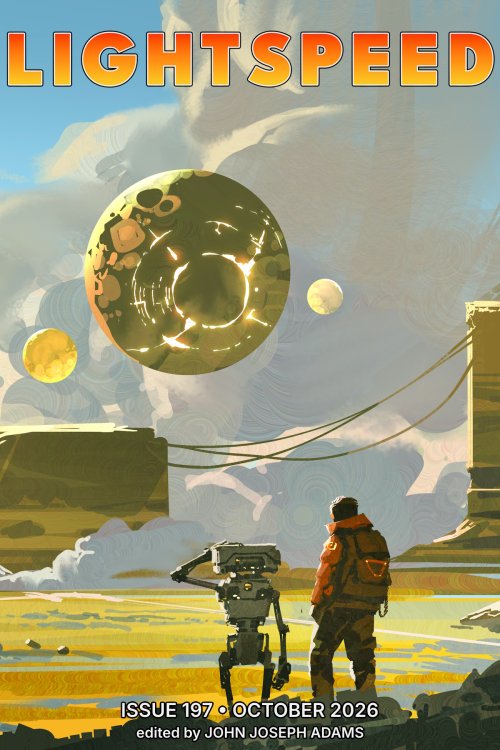
Everyone knows the Walls around the cities fell. What some people don’t remember is that the first one fell because of a laugh.
It sounded like a ringing bell. Not like it came out of a baby at all.
That was the first thing I told the scholar boy. He was a grown man, a researcher. He looked it, too. Big round glasses, chubby cheeks, curly hair.
He asked about the laugh while walking through the wet market in the parking lot of one of the old Chinatown groceries. It was early, and if you squinted downhill, you could see the shapes of gulls dipping down past the peaks of the Golden Gate Bridge, weaving in and out of the cables like kids playing cat’s cradle. I enjoy the markets, but that boy was too busy turning up his nose at the smells of fish and blood to notice all the smiles and fresh air.
I already knew he wasn’t really listening, is what I’m saying. That’s why I let him step right over Jim, who was laid out in his usual spot selling dried fish. I let that boy walk right off while I stopped. I figured eventually he’d realize and come on back. Or maybe he wouldn’t. Made no difference to me, on a beautiful day like today.
After a handful of heartbeats, Jim spoke up. “Another one?”
“I guess so.”
“Nope. Nuh-uh. Don’t even ask. I’m not saying a word to him.”
“I wasn’t asking you! Who you think you are?” I looked away and spied a little girl a few steps behind her mother, a big doll clutched tight in her arms. “He did come all the way from Eastern Canada, though.”
Jim side-eyed me, started counting fish.
“Says he wants to know about Miller’s Square.”
For that, I got the squeaky snap of sucked teeth and another side-eye. “You’ve never been to Miller’s Square.”
I eyed him back. “Yeah, but I know some folks who have. Know them real well.”
“Yeah, well they ain’t talking. Some of us like our peace and quiet.”
I shook my head, half at Jim, half at the sunshine reflecting off a pair of big round glasses hustling back from across the market.
Jim frowned like only an old man who’s embraced all his own ugly can do. “You can take him up to see her, if you want. That’d be alright.”
I sucked my smile back behind my lips and said, “If that’s okay with you.”
“You know I trust you. Just don’t—” The scholar boy ran up to the edge of our conversation, panting for breath, and Jim’s face closed up tight like a trap. Nothing to do but move on and walk that boy out of the market and over the hills, talking the whole time.
• • • •
The story he asked for and the story he wanted were two different things. They always are. He asked me about Miller’s Square and Sarah’s laugh, but to understand that you also have to understand Chicago, Minneapolis, Atlanta, New York. Explaining Miller’s Square is explaining DC, which is right up the road. If you ask about Miller’s Square, you’re asking about everything, because that was the first known wall and the first known laugh, like a ramp on the road that leads to the stories of every other major city in what was once known as the United States of America.
Sarah Prosser was only two or three years old when all this started, and she only got involved because her grandparents lived in a place that the locals called “that ham town.” They worked for Miller’s Foods, Inc.
Everything and everybody in Miller’s Square owed some of their livelihood to Miller’s Foods, which had nothing to do with bread and flour and everything to do with pork, pork products, and a delicacy referred to as Miller’s Ham. Never tried the stuff myself. Whoever owned the ham, owned the town. Just after the second pandemic, some Chinese company bought Miller’s Foods in a deal that also included most of the surrounding land, and that’s what started the Walls. You heard a lot in those days about how “the Chinese were taking over” and all kinds of nice-nasty things about “cultural differences,” but big money is its own culture and somebody local was getting rich off all that foreign cash, right? It could have been anybody, any company, from any country, who bought up that factory and started what they started. Know how I know? Because plenty of American corporations were doing the same thing at the same time, getting the same ideas, building Walls of their own, and not being nearly so open about it. Plenty of American politicians were taking their cut along the way.
You might be asking yourself how that was legal, buying up a company and a whole town with it. The answer is that the first time the economy tanked, DC snuck the Evans Treaty past us, that’s how. It granted big corporations a sort of national sovereignty like the old Native reservations had, but only if the company could prove they could afford to run their little slice of America like it was a fully functioning country. That meant they had to have infrastructure and whatnot, which was not at all like the old reservations, which had been left to their own devices even back when the USA was still pretending to care about things like public health and clean water.
The best way to prove all that was to block off some territory and run it tight like a navy boat during a war. That’s how we got the Walls. Some big multinational conglomerate or other would buy up the biggest business operation in town, the nearest school, the nearest clinic, the local municipal works. They’d annex the closest houses for the management to live in and the closest warehouses to be turned into dormitories for the regular workers. Put a wall around it all to mark their territory, and then they could show they had an infrastructure—not a good one, mind you, just a cost-effective one. Congress would cede that territory to the company and everything within it would cease to be subject to the Constitution, the Bill of Rights, or any notion of American “equality.”
You’d think the marching would have started then, but no one was paying any attention. Most people seemed to have no idea what was going on unless they lived right next to it. The country was just too spread out and the people too myopic.
Anyway, Sarah’s grandparents missed their Sunday call with their son James, which was strange, him having lost his wife only a year before. He’d just moved up to Baltimore to try and get along in life without her ghost everywhere, but he called his parents every week like clockwork, like therapy. They didn’t answer that week, and neither did other folks in town. So, Jimmy bundled his baby into his old Honda and they drove down.
He knew the area well enough to start seeing things wrong long before they got anywhere near it. A stop for gas on Route 10 was like something out of a movie, one of those teen dystopias that was popular when I was a little girl. There wasn’t a love triangle, not that Jimmy could see, but there were armed guards and dogs and a long line of big shipping trucks with the Miller’s Foods logo stamped on both sides lumbering past on the little two-lane highway.
He asked one of the guards what was going on. He got a hard, scary look for an answer, and then he got told to fill up his car and get going.
The Miller’s Square ham plant was a long white building with a red stripe, settled right in the fork where the highway suddenly divides into two. I’ve been told that everything coming up to it is beautiful country, especially in the summertime. The highway there is lined with trees so green and full that just looking at them you can imagine fresh leafy smells, buzzing bugs, and snatches of birdsong.
At this point that boy had the nerve to interrupt me and say yes, he had read all about the processing plant and the Hampton Roads region of Virginia so he was very familiar with the flora and fauna and geography and could I just get to the Wall and the laugh, please? He said it just like that, as we were coming up the steepest part of a hill.
Maybe Jimmy was just as impatient while he was standing next to his car, Sarah sleeping on his shoulder, staring at that tall gray wall and those big, long trucks rumbling in and out of the gates. He saw the guards, and more importantly, he saw the signs. “Keep Out” would have been reasonable and simple enough, but these said something strange.
I looked it up, back when I still could. The sign outside of Miller’s Square, if I recall correctly, said something like “These premises are only to be entered and used by property of New Miller’s Square Foods, Inc.” Not employees, not residents, but property. That sign is in a museum somewhere in India now, I heard.
Sarah’s father saw that and pulled out his phone. First his mother, then his father. He’d been doing that all week and no answer. Still no answer on that day, although if there had been, who could’ve heard it through the rumble of trucks and the wrongness in the air?
Eventually, Jimmy and Sarah caught a guard’s attention. He had a big gun over his shoulder—imagine that, a whole gun to defend a little ham town nobody ever heard of before. He walked up to the family, face masked, and demanded to know what they were doing there.
He wasn’t a local boy—if he had been, Jimmy probably would have known him and gotten some answers. Instead, he gave his parents’ names and asked what was going on. That guard just touched his gun like it was a woman’s face and told the man that Miller’s Square was a corporation town now, and nobody could give any information about the property inside.
That p word got Jimmy going. He and the guard got to shouting at each other and little Sarah went from just this side of sleep to all the way awake.
Most babies would have startled and probably cried, but Sarah was a little different, always was. She didn’t scream, didn’t fuss. She just looked up at her daddy’s face, then looked at that guard real hard, the way that babies sometimes do that makes old folks say it looks like they’ve been here before. Sarah stared at that man, then looked around with her soft baby focus and caught sight of the wall. She stared at it just as hard, and then . . . she laughed. Shocked all the adults into silence.
When the laugh finished ringing out, the Miller’s Square Wall just vanished.
One minute it was there and the next it was gone like it had never been.
Don’t ask me to explain it. I know how it sounds. But it happened, and that wasn’t the last time.
In the chaos that followed, Jimmy got his people, got his car, and peeled out of there. What was behind the wall was bad enough to get Jimmy to start calling every possible person he thought could set in motion the repeal of the Evans Treaty. But like I said before, money has its own culture, and it took a very long time before anyone would listen to his calls, read his letters, or look at the pictures of the sores around his father’s ankles where he had been chained to his bed at night.
Meanwhile more walls were going up, and more stories were being passed of what happens when a country’s heart becomes its wealth and not its people.
It wasn’t just money protecting itself that kept Jimmy from being heard, of course. It was also the criminal lawsuit from The New Miller’s Square Company, claiming that he had been involved in the willful destruction of private property.
There was also the media attention that the whole thing drew, and here I had to stop and sit on an old bus bench for a moment while I decided to tell the scholar boy something else that he probably hadn’t heard yet.
There’s more to any takeover than brute force. You really want to oppress people, you have to make them believe it’s progress, and that’s where propaganda comes in. America had proven in its later years that there was no better place for that than the church. Soon as the Evans Treaty passed, the president himself called up the heads of major megachurches, wined them, dined them, and made it clear that if they led the people into the valley of the shadow of death and left them there, they’d never be able to lead a camel through the eye of a needle.
I guess they don’t teach Bible study in Canada because you would not believe the crazy look I got from the scholar boy when I said that. The point was, the big churches—the ones with broadcasts, media companies, famous figureheads—got busy preaching Walls right around the time that Miller’s Square was freed. When Jimmy was sitting in the hospital reception hours later, Sarah asleep in his arms, he put on a podcast, just to have something to distract himself.
That was his first introduction to the Reverend Zipporah Douglas.
I asked the scholar boy if he’d heard of her. He had, of course, but I asked him to explain because there’s no telling what they teach up in Canada, and I wanted to make sure he had his facts right.
He sighed and fiddled with the little gadget he was using to record me, then mumbled a few quick things about how Douglas was an evangelical pastor, the CEO of a major megachurch, the moral authority behind half a dozen conservative senators and a real—well, he said “strong character,” but I heard “evil bitch” behind his words, clear as day.
He wasn’t wrong. Zipporah Douglas had drummed up public support for the Evans Treaty without telling anybody what it really meant. She’d smiled and said pretty prayers while the country dragged itself backwards to the worst parts of its beginnings. While the Prossers were driving away from Miller’s Square, they heard that Douglas woman’s voice, clear as day and sharp as knives.
“Hard work,” she said, “is an American value. And American values are good values, because they are the values of freedom, of truth, of faith. Hard work is sacred, as sacred as traditional families, the lives of the unborn, and the freedom to defend oneself.”
I know how it sounds now. Ridiculous, right? Especially since not two sentences later, she let us all know that when those same lives got too long and unlucky they weren’t worth anything unless they were adding bricks to some corporation’s Walls.
She didn’t say it that way, of course. How did it go? “No one has the right to drain our beautiful country of resources. Every American has the freedom to contribute to society, to do their part.”
The word was that she wanted to run for office herself and all her preaching was just practice. Practice, and a good way to build her brand bigger than her brown skin and “strong character” would have gotten her otherwise. She pled ignorance, but I can tell you for certain, she knew there was blood on her hands when all was said and done.
So, on the one hand, a strange little baby girl makes a Wall disappear, gross misconduct on the part of the US government is exposed, and instead of an all-out revolution in the streets, we had confusion and apathy. Most people didn’t live near a Wall yet, and with the Douglas woman appearing on all those podcasts and videos, pretending that the Walls were just a natural outgrowth of American values and God’s financial favor, most people didn’t really know what to think. Folks were too busy trying to survive and getting mad at other folks for having the nerve to do the same to really stop and pay attention to what was really going on.
Not everybody, of course. Not the folks who fought against the walls.
By then, Jimmy knew Sarah was different and was keeping her hidden when he could. He wasn’t sure how she was able to do what she could, but who is ever really sure what is happening when your child has a talent that you don’t? You just do your best to let them thrive and encourage them in whatever they do.
Besides, things were getting stranger by the second. Despite what had happened at Miller’s Square, Walls started going up around bigger towns, then around entire cities. Little Rock was the first Wall to go up around a big city—this time the corporation was good ol’ USCorp, formerly known for their big blue logos and the pack of walleyed siblings who ran it. They even tore down some of the bridges, made sure that all that could get in and out of North Little Rock by road was cargo. All the far-right folks in Montana who were stockpiling bullets to fight against foreign conspiracies and godless liberals had the wind taken right out of them by that. Then, when they started walling off DC suburbs, all of the liberals who had been relying on due process to put a stop to the new slavery started realizing that there was no longer any such thing.
We were almost at the top of another hill and the boy suddenly asked where I was while all this was going on.
I looked around and gave him half of an answer. “Oh, I was around. I was never behind a Wall, though, if that’s what you’re asking.”
“Yeah, but where were you?”
“Why, do I look familiar or something?” I turned away and kept walking so I wouldn’t see his face.
I heard him grunt and work to follow me. When this city was still called San Francisco people hated driving the hills, said it was hell on transmissions. We call it Sarah’s Haven now and all those hills are hell on the knees. They were good for when you wanted a fool to shut up for a moment so you could restart your story on the downslope, though. I took a little detour, led him closer to the Embarcadero. Not too close, though. The seals were taking over down there. I remember when they used to just be cute. We all forgot they were predators when they mostly stayed out in the water posing for pictures.
Some of the corporations took decent care of the territory they walled. Some cities never had walls, and some only had partials. That’s why Sarah’s Haven is in such good shape now, and why so many of us live here.
Most of the corporations took decent care of people, too. There’s less profit in starvation than you’d think. But a wall is a wall, and a cage is a cage, no matter how gilded. No amount of stability can make up for losing your freedom. People began to slip through cracks in those walls. Sometimes they were caught, brought back, saddled with decades of debt to work off. Sometimes they disappeared into the big black spaces between the stars of history, and no one ever saw them again but the ones who slipped into those spaces behind them.
But sometimes, they found Jimmy and Sarah. A caravan of followers started to stretch behind them, from city to city, from Wall to Wall. They called themselves the Laughers.
Time passed, more than you would think would have to. The Walls kept going up and coming down, and Sarah stopped being a baby, became a very tiny, very quiet girl. She barely spoke, she didn’t look people in the eyes, and Jimmy often found her sitting in a tight corner somewhere playing with one of the bright plastic toys that was still popular then. Always quiet, and always a toy that made no noise. Most children that age love noise, love the attention and power it brings, but not Sarah. She was as quiet as a mouse and looked a little like one, too. Hair drawn up in two big black puffs that looked like ears, sharp little face, eyes too big for it.
There’s a famous picture of her standing outside the Detroit Wall with a big pink plastic key clutched in one of her little hands. The Reverend Douglas started adding little jabs at her in some of her speeches and interviews when she saw it. She went so far as to say that the child was a foreign plant, a cute shill for a sinister conspiracy to bring the whole country down in a pile of cracked concrete. She even called her a biological weapon. It was just more words, piled up to block the view between her followers and the truth.
The problem was, Sarah wasn’t a child in a storybook who obediently goes on quests and does the bidding of her knight protector. She was so sensitive that a truck rolling past could send her into a month-long silence. She was so distant that you couldn’t be sure if she ever understood what you were asking her and so quiet that you’d rarely get an answer even if she did. Jimmy and Sarah spent most of their time hiding while the world remade itself around them.
In other words, that laugh—that magic, wall-busting laugh—was not just weird, it was unreliable. Jimmy had it in his head at first to drive Sarah around the country like some sort of baby-faced brick buster, giggling and ripping down walls as she went, but the truth was, that rarely happened.
When it did, it was notable. Birmingham, Providence, Reno, Pontiac, Flint—all of those walls fell to the laugh. But Philadelphia, Las Vegas, Chicago, St Louis—those all fell because of the laugh, but not because of Sarah herself. People tell stories, you see. People slip through the cracks in walls and then back through with seeds of revolution braided into the rows of their hair.
But Walls were still going up faster than they could be laughed down. The powers that be, that money culture, were trying hard to hang on to the last of a conquering industrial past that never really should have been. As Walls fell and as—how did they put it?— “investments soured,” the ways of protecting those investments got more aggressive.
Word was getting out that that life inside a Wall was really no life. People were chained in their rooms at night, didn’t have enough food, and were made to work long, hot hours for nothing but broken promises. Hundreds of walls had gone up and only a few dozen had come down. Sarah had been taken to twice that many, but she was just too deep inside herself. In Atlanta she sat on the ground staring at a dogwood blossom that had fallen on the road for three hours and never once turned towards the wall or made a sound. Eventually, they just had to pack her up and drive away to the next place, picking up runaways as they went. Some months later, Atlanta liberated itself.
But still, there was nothing like Sarah’s laugh to bring a Wall down.
The last one was Denver.
The Denver Wall was confusing, even to the people who had put it up. There weren’t many factories there by then, to begin with—there were a few big techs and a lot of midsize corporations that dealt in pushing money from one place to another on behalf of bigger corporations. Who puts up walls around accountants?
But Denver also had one of the largest unhoused populations in the country at the time, and somebody whose daddy got rich building walls tried to look like he knew what he was doing by putting them all to work, and their richer neighbors, too.
When Jimmy pulled up to the Denver Wall with Sarah, there was already all kinds of pain and anger boiling up from behind that wall and leaking out into the free world.
The Douglas woman was nearby too, having a rally. By then she had started campaigning for president. Folks surrounded by walls don’t vote. The company shareholders do it for them. There was no need for that Douglas woman to be in Denver that day, but she loved a ceremony, so there she was, making a big deal of showing how much of a problem the walls weren’t, firsthand.
Jimmy knew that the noise would scare Sarah too much for a laugh, but he brought her out anyway, wearing a big pair of pink muffs over her little ears and clutching a big pink plastic key. It’s a wonder that it worked. Denver was chaos. Riots inside the walls, fires in the old downtown, and so many guards holding guns like lovers at the gates. The Douglas woman had set up a tent and was having, of all things, a prayer meeting. She did that at every stop. Said that she wanted to show the world that America was a Christian nation. I guess the Roman lions thought they were close to heaven too, since they were gifted with all those prisoners to eat.
Jimmy waited with Sarah as close to the gates as he dared, a few dozen Laughers with him. They made a circle of RVs and camper vans, close enough to see the wall and the smoke from the fires, but far enough away to keep the guards from getting nosy and hopefully keep Sarah from getting upset. She never saw anything too terrible herself, you see. Jimmy wasn’t a bad father in that way. Besides, she had to laugh to make it work.
The Laughers could hear the organ music and shouts of the Douglas prayer meeting floating to them on the wind even over the sound of burning buildings. They waited and listened, waited and stared at Sarah.
She cried a little, ate a snack, played with that plastic key, and never once made a move to snatch those earmuffs off her head or look her daddy in the eyes. Eventually, she crawled up in his lap, snuggled up under the scratchy gray stubble on his chin, and went to sleep.
Sarah was peaceful but Denver wasn’t. There were screams, and shots, and over it all the thump and rhythm of a good old-fashioned church service. Someone had a little tablet and on it they live-streamed the national news service’s coverage of it all. No mention of the fire and blood inside the Mile High City, but lots of shots of that Douglas woman’s carefully made-up face. Lots of audio of her speaking on how great a beacon of progress and prosperity Denver was, and how the CEO of the company that owned it was at that minute heading into space on a rocket he bought with his own money, expanding the kingdom of heaven.
The people with her heard all that, cheered, screamed, and fell out compelled by some power. The cameras scanned their faces, showed their profiles. These were good citizens. No mention of the ones fighting for their lives just a few feet away.
Somehow, the Douglas woman got the idea to move her prayers to the gate of the Denver wall. For all her bluster, the Douglas woman didn’t know how bad the situation inside the walls really was. The self-righteous bitch had drunk the corporate morality Kool-Aid and still thought that the complaints and rumors were the results of laziness. She believed her own lies. But she shouldn’t have.
It finally dawned on the Laughers that they didn’t have to wait for Sarah to help the people fighting inside of the Denver Wall. Took them long enough, but they started heading for the gate, too. Jimmy followed, carrying Sarah.
I stopped for a moment to catch my breath, took a sip from the little pouch of water I keep at my side. I looted it from one of those fancy outdoor shops back when I was on the run, right after I started to figure some things out, admit the truth to myself. The head of the corporation that owned those shops fled to South America, I heard. All kinds of interesting things were left behind. I still had the hiking boots I’d looted from there.
The boy historian was looking at me like a person, finally. I asked him what he was looking at, and he had the nerve to open his mouth and say he never heard the story I was telling him. Not in a snotty way, for once, but it still got on my nerves.
“Of course you never heard this. Nobody tells this story anymore. Most folks are too ashamed or traumatized to tell it all. Except for Sarah. She can’t tell you, or at least I never heard her try.”
He cocked his head, looked at me like he’d had the first original thought of his whole academic career. “But you were there.”
I nodded. “I was. Guess I’m not too ashamed to tell some of it. You want to hear the rest or what?”
He kept his eyes on me, and we kept walking.
It was starting to get dark when the Douglas people and the Laughers saw each other coming up to the gate. Right away that woman knew she’d made a mistake. There were bodies on the ground. But she’d come too far to turn back now. The eyes of the world were on her, live.
Fortunately, Sarah didn’t see any of that. She was having good dreams. That little girl, curled up tight in her father’s nervous arms, stretched a little in her sleep, yawned—and then she laughed.
Even in the distance, people heard it ring out.
Silence fell.
And the Denver wall disappeared.
One of the Laughers who settled here in Sarah’s Haven was close enough to see the look on the Douglas woman’s face when it happened, in person. It was also on the screens of everybody at home. All of the people who hadn’t been touched by the Walls personally but didn’t know what to think except what they’d been told suddenly saw reality. It’s one thing to be told something is good. It’s another thing to see how evil it is with your own eyes.
People started going to their nearest walls, wherever they were, and ripping them apart so that they could try to care for the people within. Trade, production, all of that, had been disrupted so thoroughly by then that the country did finally fall apart. The economy, you know. Everything was tough. Still is, but we rebuilt. We settled in the better-kept cities, do our best to live in a way that doesn’t need walls.
I found Jimmy right after the Denver wall fell, you see. I took off my lapel mic, dropped it in front of where the Denver gate had been, left the cameras and crew and the whole rally right where they stood, gawping at the fire and fury revealed by the disappeared wall. I walked right over to the Laughers, just as entitled as ever. Sarah was still asleep, and Jimmy recognized me right away.
I asked to join up with them, but that man was no fool. He cursed me, and I deserved it. He left me standing right where I was, got in his caravan with his daughter and drove off.
It took me a while to find him again. My old friends—well, accomplices, really—were all either losing their power outright or using it to hide somewhere the mobs couldn’t find them. I didn’t want to talk to them anymore, and they all wanted to kill me. I wanted to die, but I didn’t feel I deserved something so easy. The evil that we’d allowed—it did more than shock me. It hurt me, to know what I’d done. What I’d encouraged.
But the people I wanted to talk to didn’t want to talk to me either, not after who I’d been. Could you blame them? One time, a group that was searching for the Laughers to join up with took me in and fed me dinner. When they realized who I was, they let their dogs chase me away from the camp.
I held my left arm out to the boy scholar, showed him the back of it. “You see that scar? It’s from where I fell and got cut, trying to get away.”
Scholar or not, he sure was slow on the uptake. We’d reached Coit Tower at last. It’s called Sarah’s Home, now. I had my hand on the door, pushing it open for him when he suddenly turned his head and looked at me hard, like he hadn’t seen me this whole time.
I pretended I didn’t notice and went into the tower, calling for Sarah as I went. It’s hundreds of stairs to the top, but we’ve moved some things around and knocked down a few walls in what used to be the lobby. Now it’s an open sitting room full of plants and soft things. Sometimes when Sarah gets the mood, she’ll climb all those stairs, spend hours staring out over the water, but not today. Today she was sitting in her chair like she usually is, with a bit of soft cloth in her hands. She grew up but stayed tiny. Eyes still big, hair still pulled into a puff that makes her look small and soft, despite what we know she can do. Although, who’s to say that you can’t be soft and knock down walls, too?
I had a talk with Jimmy when we first settled here. I’d followed the Laughers all the way to California, and because I was in real danger of starving to death, I didn’t have the sense to be scared. I used to get as close to the ring of Laugher campers as I could and beg at the top of my voice. All that preaching was practice, but not for public office, it turns out. I begged and pleaded until they finally let me in, and to this day I’m not sure if it’s because I really changed or because I was so annoying.
Either way, when they finally let me in, I was brought to Jimmy. The Laughers weren’t gentle with me, and I still had a slice on the back of my arm and a healthy fear of the camp dogs. My throat was hoarse from all the pleading I had done.
Jimmy was sitting in a camp chair. His daughter had the Laugh, but the man had been the leader of the movement, and that does something to a body. Ages you. He was already starting to shrink up, to get old. Other folks told me his hair went completely gray just in the year or two it took to get all the walls knocked down.
He was knotted up in one of those folding camping chairs. Sarah was sitting on the ground next to him, playing with something bright and plastic and yellow. Jimmy opened his mouth to ask me something—probably what I wanted with him, but Sarah stopped him.
That child. She looked up at me and she smiled. I flinched. I really thought she was about to laugh me out of existence. It’s what I deserved, after all. But she smiled, and she reached for me, and in her little soft voice, she said, “hi.”
“Hi.” Just one word, but that was more than Jimmy had heard from her in months. One word from Sarah meant that she’d taken a serious shine to me, and once they got over the shock, everyone more or less tolerated me. I had been chosen, after all.
I stopped calling myself Zipporah Douglas. Douglas was my ex-husband’s name, anyway. I stopped calling myself anything but Sarah’s Keeper, because that was what I was, who I became.
Jimmy didn’t like it at first, but I felt that it was only right. Somebody needed to look after her, tiny and quiet as she was. Somebody needed to pay attention to her, make sure things weren’t too loud, food wasn’t too hard or too squishy, talk to her, treat her like she was something other than a tool. Somebody needed to treat her like a child. I’d never had children and had no idea how to do that, but I felt so terrible that it was a relief to lose myself in trying. It freed Jimmy up to do other things, at least until he got too interested in fishing to do much else. Now I keep folks from each other’s necks like he used to and keep making sure Sarah’s well-looked after.
Sooner or later the Walls would’ve come down, with or without her. But I never would have changed, not really.
I swear schools in Canada don’t teach a drop of critical thinking anymore. After everything I’d said, that boy just barely got it. He just kept looking from me to Sarah and back again with his eyes all bugged out.
“You? You’re the Douglas woman? What are you doing here? Does Sarah know?”
You see? It was like he hadn’t heard a word. I shrugged, and said, “Took you long enough.”
My eyes were on Sarah. Hers were on the scholar, steady. I still never really know what she’s thinking. I just know that she is. I do wonder how she sees the world. When she looks at people like the scholar boy, does she see the parts of him that could build Walls? Or something else?
What about when she looks at me? I used to flinch every time she smiled and opened her mouth. But she hasn’t Laughed since Denver. I guess there’s nothing as ridiculous as the Walls around, not anymore, not around here.
She was looking at me now, and her mouth was turning up at the sides. I’m long past the days where I care if she Laughs me gone, but the scholar stepped away, his eyes bugging out even bigger.
Sarah’s mouth opened, and she spoke, said something I never heard from her before, something I never expected. Something almost as ridiculous as a Wall.
“Zipporah,” she said, “Love you, too.”
And I laughed.
Enjoyed this story? Consider supporting us via one of the following methods: