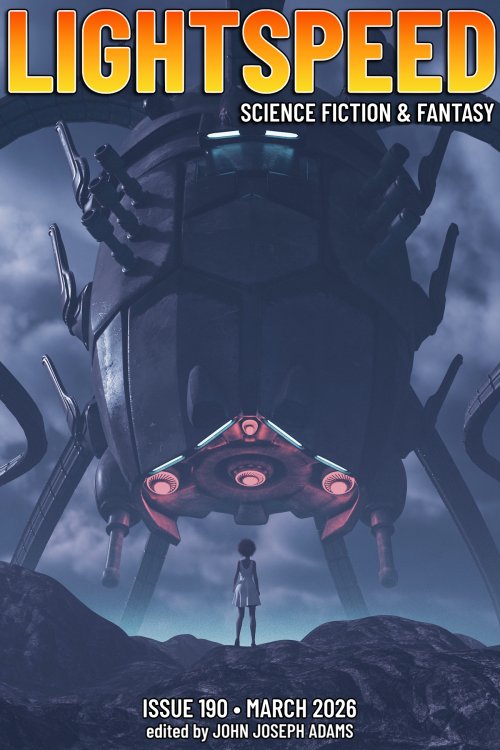
The settlement was barely two weeks old, and so her own habitation husk had to serve as an ER room for the man who was carried in from the planet’s surface, screaming and blue-lipped with trauma shock.
“What happened?”
The doctor listened as the man’s coworker explained how he had been guiding a transportation eelcraft when something huge and obscure rose from the river, crushed him against the bank, and made off. The patient was miraculously conscious but incoherent with agony.
“All right, lad, all right,” she soothed, noticing with relief the lack of blood on the medical cocoon covering him. Then noticing the lack of shape beneath one half of the cocoon entirely. “I’m just going to take a look—”
She pulled back the covering and froze mid-gesture, processing the sight. The man’s naked lower half was integral down to the bruised genitals and hips—but his legs disappeared mid-thigh. There was no wound. The skin was clean—pristine, even—as if no legs had ever existed at all.
• • • •
The next day the crew gathered on the Scholion’s bridge to discuss the situation. The doctor listened as the xenobiologists described the eerie lack of fauna on the planet Ladon-b: no birds, no insects or mammals, nothing in the water, nothing that could have inflicted such a bizarre wound on a man. The injury was as nonsensical as it was motiveless.
The meeting was abruptly ended by a screeching cacophony of metal outside.
Through the viewscreens, the crew watched as the rods girding the habitation husks clattered apart, sliding down into the violet soil, fiberglass walls and poly-plastic window fixtures falling into ruinous piles. At the peripheries of the dust clouds kicked up from the earth: the impression of whickering fingers, as of a centipede, or a million pale-flamed candles.
Something in the ground had taken the very bones of their buildings.
• • • •
The colonization mission became an evacuation after that.
More things began to go missing as they packed up the husks: battery packs, engines of all kinds, solar panels and cells. The more superstitious of the crew began to suspect a phalanx of poltergeists on this new planet: playful spirits taking things from boredom, hurling them down in slow-motion cascade, enjoying Ladon-b’s weak gravitational forces.
After a day of inactivity, and just when the doctor had begun to suspect mass hysteria, she was wrenched from sentry duty by the sound of four people, screaming, from the bridge, the pastel electronics of the command deck making gross highlights of the curtains of blood pouring from their empty mouths.
“The floor, the floor!” the director cried—and she looked down in time to see four arterial fibers moving whip-quickly around her feet, carrying four bloodied tongues in their wake.
• • • •
They left sixteen days after planetfall.
The Scholion had almost reached the upper atmosphere when the crew, strapped into their seats, suddenly found the shock and fire of stratosphere beneath them as the floor of the ship was torn away. The doctor tumbled, fighting to stay conscious. She had the impression of falling through a forest in the air. Gray, trunk-like arms reared around her, grasping the cylindrical molding of the Scholion’s engines, tapering all the way back down to the ground. Her coworkers tumbled out of the sky like toys, like little machines. The tongueless four she had worked so hard to staunch and bandage and sedate were taken apart with an almost languid dispassion by the questing alien fibers.
More screams she wouldn’t forget.
She lost consciousness as the seat’s parachute deployed and she drifted, slumbering, down to the surface, landing softly on amethyst moss. What had once been the ship scattered about the landscape in a miles-wide radius, as did her crewmates.
She would never see any of them again.
• • • •
An alarm like a mosquito, high and hectic. Waking to fogged helmet interior and the gently lapping waters of the marshland. Violet grass between the fingers of her gloves. The doctor pushed herself to sitting.
A clearer sound, shockingly intimate in her ear. A voice.
**HAPPENED**
Garbling interference. Mist rose from the swamp; moisture filmed the inside of her suit. Her neck felt like stone, the helmet a sudden crushing weight on her. She pulled it off. Left the earpiece intact in case anyone else had survived.
Lights suddenly spangled the dense air in the distance: white and blue and electric yellow.
“Is anyone there?” she spoke. Hoping. Voice glutinous, throat like paste.
A noise unlike anything she had ever heard bellowed out in answer. A whale’s roar, the shredding susurration of a jet engine, the crackle of violent fire combined. Something vast and skeletal loomed out of the mist.
**ALL RIGHT LAD ALL RIGHT LAD**
Rods that had girded their habitation husks were now pistoning legs, on top of which an amalgam of all the stolen things quivered. A ten-foot skeleton with a bloated belly, a stilt-walker in mud-thick water, a mantis with iron raptorials. Mechanical parts lashed together to form a crude, meters-long effigy of a human face. Four red and glistening shreds of muscle swinging around its jaws, stitched awfully together. Not like a human mouthpart at all. Nowhere near.
Horrible clarity of form as the mist gave way around the creature. Eyes ribbed with plastic filaments beamed out like twin lighthouses, set into the skull of the thing. Metal piping pulled its face open: a factory smiling, a chimera of flesh and steel mimicking her own rictus. Too much red, entirely.
Before her mind broke she noticed more organic matter: A pair of muscular human legs swung around the thing’s waist, or at least partway up the body, because the planet had not wholly understood what it had taken—only that what it had taken was, somehow, integral.
The thing was close enough for her gaze to become lost in the snarl of industry and ingenuity it had taken to assemble itself; the more she looked up at it the more of them, the colony, she saw. Pipes. Beams. Nails. Sheet metal. Silica.
Keratin.
It loomed over her to speak, and spoke with a soldering voice, more play than speech.
**FLOOR, THE FLOOR**
The doctor looked down. Her own legs, pitifully small, knees cushioned by moss, tapering shins, down to rubber boots that had remained, miraculously, intact. In the shadow of the creature she saw its own metal points, its own impoverished stumps that somehow kept it standing—but only barely.
She nodded. Lightness in her head, in her mouth. Lightness all around.
The doctor pulled off her boot as the thing extended an arm like a firehose, and at the end she saw the lamprey-like harvesting implement of one of the eelcraft; starlight spackled upon its razored surface.
“Take them,” she said, tugging at her other boot, exposing skin glistening with perspiration in the dank. Separated from her body, the boots suddenly became the funniest thing in the universe. “I’ll show you how they attach to a body.”
The creature swayed, burbling metallic happiness, and its arm extended down to scalpel the sheet flesh and nodes of bone separating her leg and her left foot. It chattered as it worked. Pain guttered up from her ankle, and she wished so dearly that she could hear birdsong in that moment, or the chatter of people—even screams would do—something, anything that wasn’t stolen and yoked together. At least this was a gift bestowed. She remained unviolated in her benevolence; she was choosing this, and she was not a victim.
**MINE** the creature said. **SHOW YOU**
And it did: shifting its weight from one leg to the other. Iron joists slid into the meat of its new ankles, snapping into place around exposed bone as if molded for that purpose. The toenails glinted a tropical pink, diabolically cheery against the rusted carapace. It supported itself easier now, its mass distributed between two beautifully formed human feet.
It told her how happy it was, as best it could, as she wept into unconsciousness, lifeblood venting from the stumps of her ankles. It continued its monologue even when she had fallen silent, chattering with stolen vocal cords in a language it had not fully mastered yet but was, nonetheless, making its own.
Enjoyed this story? Consider supporting us via one of the following methods: