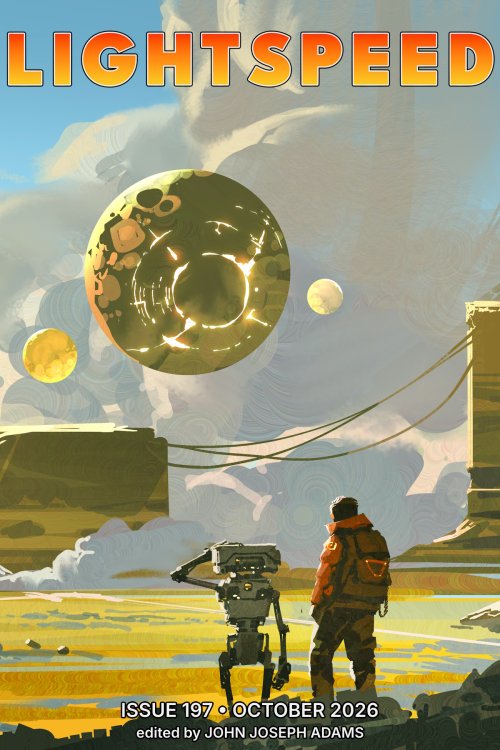
We’re so happy to have “Dreamweavers” as one of the science fiction stories for this month. Can you tell us about what inspired you to write this story?
It was during an AI & Creativity Conference at Stanford that I first heard about Sam Altman’s truly horrifying next endeavor called World Coin. If you haven’t heard of this particular dystopia, it involves an eye-scanning orb that’s being sent to many third world countries to scan the retinas of those who volunteer. In turn they get world-coin credits, basically a new kind of cryptocurrency that will be based on eye-scans, and a horrific way to monetize and create a global surveillance network for the tech overlords. Between this monstrosity and the other horrors being wrought by the nefarious broligarchs who wish to use humans as cash cows and guinea pigs (see Musk, Zuckerberg, Bezos, etc.) I began feeling an incredible amount of heartbreak and hopelessness about the state of the world.
Meanwhile, everyone and their grandmas were rushing open-armed into AI, though it’s rapidly destroying our remaining drinking water and putting millions of people out of jobs. It was with this sense of Kafkaesque frustration that I dove into the world of “Dreamweavers” where data centers have turned the world into a dustbowl and all that’s left is the evolving digital dreams of tech barons who want to splice humans with machines. In the story, we’ve become beholden to them as they move toward their ultimate dream: transcending the physical body so to upload our consciousness to the digital platforms they control.
Much of the story was unformed as I began writing, I followed the themes of totalitarian tech for the emotional core of the story. However, the original seed of “Dreamweavers” started nearly seven years ago. I was flying over LA on a red-eye and looked out the window at the wild sprawling lights of the city below. I’d just woken from strange dreams, and I wrote the sentence, “Good people who shaved their beards and could be found hawking micro-dreams; lost souls who became circuit-board connoisseurs; vein-wired baristas serving lab-grown charcuterie beneath rooftop bistros.” It was a strange, wily voice and I didn’t yet know what to do with it, but I sensed there was a story there—about how we’ve lost people to the city of lights and electricity, about needing to venture into the heart of the beast to save them—which is a metaphor for this digital dystopia we’ve created.
Do you hope your story will rally people into action?
I’m always hoping my work will help remind us of the need to fight for a more just, ecological world that belongs not to capitalist (and nihilist) overlords, but to us—the people. My hope is that we might begin taking hammers to our phones and step away from the digital heroin we’re all mainlining. I think it’s up to us to unhook our kids—or maybe it’ll be our kids who will unhook us. I’ve heard evidence of this happening, that the youngest generation are sick with social media and the need to upload everything and are beginning to move offline while we simultaneously race toward the AI apocalypse.
My feeling is that we’ve been seduced into a digitally transactional economy wherein we’re posting our private lives constantly. Basically, we’re becoming an Only Fans culture—some are selling themselves through porn, others are hoping to gain followers through yoga poses, new-age folks are promising to teach us how to live our juiciest lives, and still others are simply unboxing stuff for views. This isn’t the way humans thrive nor how we build community—it’s the way we destroy it. So I have a great hope that my stories can be part of a larger collective movement toward awakening from this particularly Orwellian future to rekindle our communal ancestry.
The importance of sustaining hope plays a large part in this story. What are some ways you personally keep hope for a better future alive?
Without hope I couldn’t write, and in many ways most of my fiction deals with the need for hope and the reminder that we’re all together in this thing called life. There are far too many people out there who have forgotten that we share this Earth together. They’re busy fighting over borders and starting wars and trying to make money by selling people out and robbing the commons. On top of that you’ve got the rise of fascism with yahoos wrapped in American flags with Replacement Theory paranoia, Christian White Nationalists holding Turning Point rallies where they rebrand the Salem Witch trials . . . I could go on and on . . . I mean, we all know things are bonkers right now and very, very dark. So we need hope. I sure need hope.
My hope is that we will come together to solve the world’s biggest problems. For some reason, we find endless money for war, corruption, and disempowering the most vulnerable, but when it comes to lifting everyone up—that’s considered socialism. Billionaires like Musk and Bezos could become benevolent benefactors, instead they launch dildo-shaped rockets into space and eviscerate USAID. There’s blood on their hands, and I hope these narcissistic maniacs will awaken to the suffering they’ve caused and use the rest of their lives and fortunes to alleviate the deep harm they’ve wrought.
As for me, one of the things I’m really invested in is creating nurturing spaces where we reconnect with one another creatively. I founded The Martha’s Vineyard Institute of Creative Writing (mvicw.com) seventeen years ago, and every summer I’m awed by the way we work together to create a community rooted in love and compassion. The transformation that happens when we support one another is magical and it’s the ground from which we can begin a much larger transformation.
How do you think we can all stay in touch with our humanity in this increasingly technological age?
The most immediate thing we can do is disconnect. Stop scrolling on Instagram—in fact, just delete Instagram and Meta apps, take LinkedIn with it, and Snapchat and on and on and on. Reinstall landlines. Turn the computers off and reengage with our children, our partners, and our family and friends. In many ways this is the hidden theme/metaphor beneath “The Dreamweavers.”
We can also create spaces that aren’t based in rapacious capitalism. We can create collectives in our hometowns where we come together to exchange ideas and contribute what we have as offerings. We can bring back the gift economy. For example, donating an hour of yoga every week as an offering, or an hour of therapy; if you’re a writing teacher a free workshop in the community; if you’re a farmer—a bushel of produce, and so on. We can move away from exploiting our talents to create Instagram reels where we siphon money away from friends, family, and strangers. We can turn away from the influencers. We can be in service instead. We can support indigenous communities. We can take part in healing ceremonies, explore grounded, healthy uses of psychotropics and plant medicines. We can care for nature, cultivate fruit trees, and create a community orchard like what Ross Gay has been part of in Bloomington, Indiana. We can stop giving our money to Amazon, Target, Walmart, and corporations, and reinvest in one another, and our lives that we’ve given away so cheaply.
Is there a project you are currently working on? And if not are there any themes, objects, or news that might be tickling your fingers?
“Dreamweavers” is part of my new collection, Transcendence, which is currently on submission. I’ve finished my first novel, The New King, which is a post-apocalyptic Huckleberry Finn with a twelve-year-old boy who’s heading to New Orleans to face off with a malevolent self-appointed king that’s created a city of bacchanal violence. My first screenplay, Autobiography, recently sold to A24 and begins filming summer of 2026—so that’s immensely exciting. And then I’ve been exploring writing a musical with the incredibly talented musician, The Philharmonik. So, I’ve been branching out across genres and projects which has been deeply joyful.