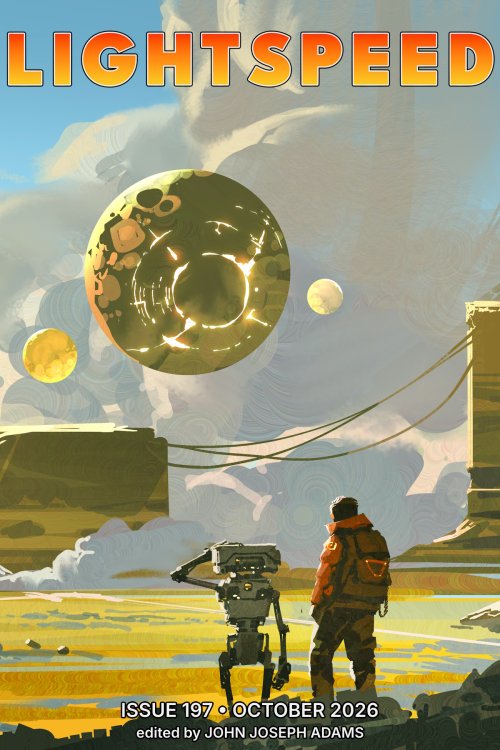
Editorial
Editorial, March 2013
Welcome to issue thirty-four of Lightspeed! We’ve got another great issue for you this month; read the editorial to see what we have on tap.
Lily is the protagonist in a fairy tale when she arrives. She has a problem—her own dissatisfaction with her life—and so she goes on a journey, a sort of quest. She arrives at a magical place and meets the people who are to help her along the way.
I wanted to tell a personal story and an epic story without directly telling either one. We would see them both from a distance, in relief. One of the things that I think is powerful about this is that it requires the reader to fill in so many blanks, that the experience requires more reader collaboration.
Q: To what extent do you think the future depicted in the Vorkosigan Saga might actually come true? A: In bits and pieces, I think it will. The space travel part I think is entirely bogus at this time. There’s no reason to believe that we will ever have cheap, easy interstellar travel. Other parts of it—usually the parts that I concentrate my plots on—are more realistic: the biology, the biotechnology, the genetics, and the genetic engineering, they’re more grounded.
The first inkling I had of this story came when I was visiting a heron rookery (or, technically, a “heronry”) in my home state of Ohio with my mother. Herons are very nervous, and they often respond to intruders by vomiting down on them—which is both unpleasant for the visitors and very bad for the birds. So we were only allowed to visit because it was winter and the nests were empty.
Technology can definitely help with some aspects of parenting. Old-fashioned technology provides invaluable help in the form of washing machines, dishwashers, fridges, and vacuum cleaners—not to mention vaccines and other medicines. Newer technologies such as video conferencing mean that you can communicate with your child when you are away from them. In the future, I expect there will be excellent software to entertain and educate children. Instead of a child passively watching a TV program, children could interact with the program.
Some people on the Malazan Empire fan site were sort of saying, why go for something where we know what’s happened? My response would be you only think you know what’s happened. One of the things I’m pushing for is the notion that history is not an accurate portrayal of anything at all.
Q: It seemed that the bond between the characters was strengthened with each sentence. How did you distill those developing emotions into such a small package? A: How I did it lies in what I did. It’s not a mystery, really—you’ve distilled it in your first sentence. To know more than that, you just examine the details. Each one takes a step from fear and loathing to acceptance and dependence.
The attraction of steampunk is […] piling together all these disparate aspects and finding a way to make it all work. One way to look at it—this is Jules Verne’s Paris, and the thought of dirigibles mooring to the Eiffel Tower just seems so perfect you wonder why it never happened for real.
[To create this image,] I fantasized about war and battle and a good story to paint. The idea was to paint a strong female fighter who knows her limitations, not the type who beats twenty well-trained men, then dusts off her shoulders and walks away—not the Hollywood type of hero. A warrior that has feelings and needs to rest; she could be sad about something while taking a break.