Author Spotlight
Author Spotlight: Benjamin Peek
I just like strange things.


Advertisement
I just like strange things.
Looking for more terrific short fiction? You know Arley Sorg is! Luckily, today he’s recommending New Suns 2 edited by Nisi Shawl, the follow-up to 2019’s fantastic New Suns, and just as fun.
If I’m writing a short story, I like to plan everything out in advance and then write from the bullet points; there’s not so much wiggle room when you’re writing against a maximum word count. If I’m writing a novel I also like to plan everything out in advance and write from the bullet points, with the difference that I generally get maybe two-thirds of the way through and realize that two or more of my bullet points conflict with each other and the entire house of cards is gonna collapse.
There’s a common slang we have in Nigeria called “japa.” This simply means migration from your country to another country for better opportunities and greener pastures. I was having a conversation with a friend who was talking about the hardship being faced by the ever-growing Nigerian population, hence, the reason for the mass migration. A spark of an idea was birthed during the conversation. What if this supposed greener pasture is not what we think it is? Perhaps, we are too engrossed with the news we hear about such places.
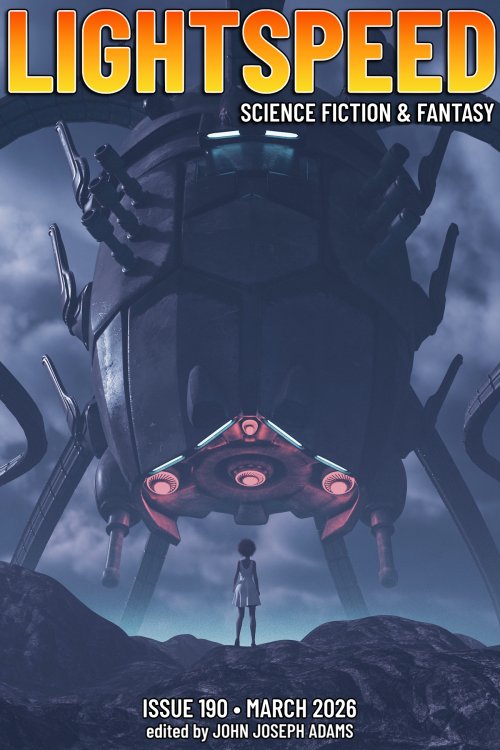
Be sure to read the editorial for an entertaining rundown of this month’s terrific content.
I like to think I’m a nice dad. And, possibly as a result, I write a lot of science fiction with nice dad protagonists. For this story, I wanted to challenge myself to go in the opposite direction and write the villainous origin story of a not-very-nice dad. So, I basically fought my best instincts as a parent, and explored a much more selfish point of view. Like most of my short stories, this is just a jumping off point. I’d love to write more about what happens in this cave with these people.
Are you looking for a book about pirates? Let Chris Kluwe tell you why The Adventures of Amina Al-Sirafi by Shannon Chakraborty might be the piratical read for you!
This really happened to me! But without the monsters. When I was ten my father got in a bad motorcycle accident, and my mom had to rush up to Albany Medical and left us in the care of family friends who were significantly wealthier than us. It was terrifying (and fascinating), and the scars on my psyche festered into this story after about thirty-plus years.
Reviewer Arley Sorg is always seeking out new, fun, and important short fiction, and new anthology Queer Little Nightmares edited by David Ly & Daniel Zomparelli perfectly hits the brief.
Widener is a real library, and a really weird one in many ways, although renovations since my undergraduate days have tidied up things like the passageway that literally went out a window. I’m a folklorist by training and inclination, so it wasn’t hard to take the structural oddities and graft on some additional weirdness.

Advertisement

Advertisement

Advertisement

Advertisement

Advertisement

Advertisement

Advertisement