Nonfiction
Book Review: Spider King, by Justin C. Key
Reviewer Arley Sorg says: “Justin C. Key’s Spider King is a short, stirring read.” Want to find out what makes this serialized novella so worth reading? Check out Arley’s review!


Advertisement
Reviewer Arley Sorg says: “Justin C. Key’s Spider King is a short, stirring read.” Want to find out what makes this serialized novella so worth reading? Check out Arley’s review!
LaShawn M. Wanak says in her new review: “It’s been a while since I read something fun. Something joyous. Charlie Jane Anders’ first venture into the YA genre, Victories Greater Than Death, did not disappoint me in that regard.” Read her review to find out more!
“The Giving One,” like all the Burnt Empire legends, is loosely based on a legend from the great story cycle, The Mahabharata. I first wrote about it in my Mahabharata Series published in India over a decade ago. I adapted it freely and brought it into line with the timeline and character history of the Burnt Empire trilogy, especially A Dark Queen Rises.
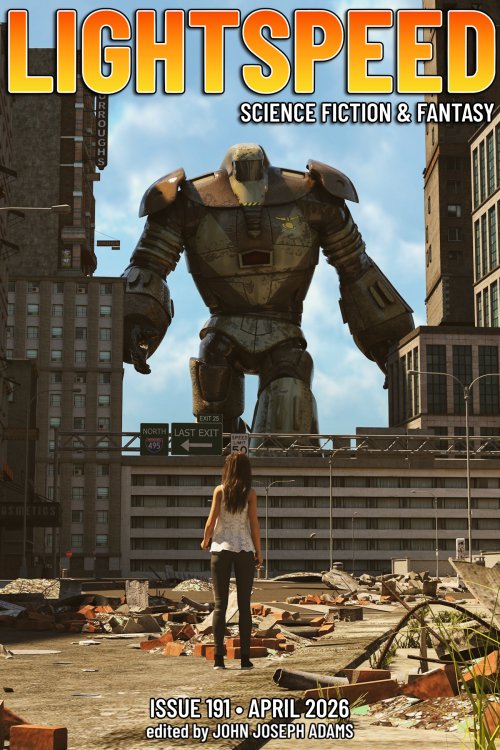
Be sure to check out the editorial for a rundown of this month’s delightful content, and of course, all our news and updates.
Given all of that, how did my consciousness end up in this particular skull, right here? Why do I have an experiential reality, and why is it (to the best of my awareness) singular, distinct, and specific to this body, this place, and this time? I’m a consciousness, you’re a consciousness, why don’t I have the inherent access to your experiences and not my own? Why does my “I” pointer point where it does?
Arley Sorg loves short fiction as much as you do. Let him recommend a new short fiction collection for your delectation!
I definitely envisioned [magic] as somewhat secretive, a hidden and inherited talent shared either with others who possess it, or with close loved ones. I conceptualized it as similar to empathy, in some respects. Unlike magic in this story, most people are capable of feeling deep empathy. (Whether they choose to indulge it or not is a very different question). Some people, however, inherit a much more intense capacity for feeling empathy toward others—which can make relationships much more enduring and satisfying and joyful, and can absolutely saturate the world in emotional color.
Chris Kluwe recommends this new novel by Nicky Drayden. Find out why!
I don’t think I’m a particularly close observer; I am sometimes thoroughly blind, to the point where I am surprised by explosions that end with me protesting, “I didn’t know you were upset. I’m not telepathic.” I never take notes, but some of what I do retain is internalized, and winds up on the page. Here, it was a case of realizing, “This man and wife cannot exist in a vacuum and it already feels like they do, so I better give them a hint of a larger existence; here, I’ll have the protagonist visit his father.”
Do you like military fantasy? Will you like The Unbroken by C.L. Clarke? LaShawn M. Wanak reviews this new novel of colonialism and romance.

Advertisement

Advertisement

Advertisement

Advertisement

Advertisement

Advertisement

Advertisement
