Nonfiction
Book Review: Chimera Skin by Johnny Compton
Melissa A. Watkins recommends Chimera Skin for fans of I Am Legend or Slaughterhouse-Five.


Advertisement
Melissa A. Watkins recommends Chimera Skin for fans of I Am Legend or Slaughterhouse-Five.
As I’m sure you know, this story was written as part of a Dartmouth University project where speculative fiction authors were paired with Dartmouth faculty and asked to write something inspired by their faculty partner’s research. I was lucky enough to be paired with Jane Henderson, whose work focuses on the concept of “human geography.”
I had recently read Ilana Masad’s Lambda Award-winning novel, Beings, which is a semi-fictionalized account of the abduction of Betty and Barney Hill, intertwined with the account of an archivist uncovering a queer, historical romance. I adored the book and knew I had to write an alien abduction story!
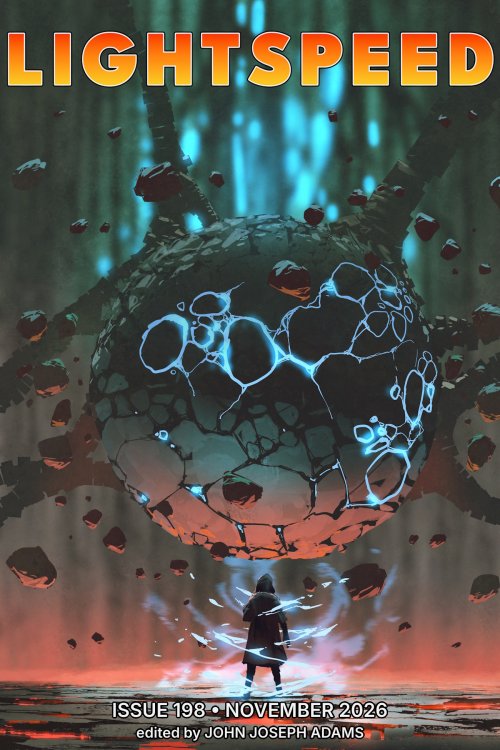
This month’s original science fiction offerings are by Jenn Reese (“A Map to Sideways Places”) and Georgina Kamsika (“On the Thermodynamics of a Perfect Cup”). Our two science fiction flash pieces are: “Selected Case Notes from the Judicial Oversight Council of the Gatarn Empire” by Ian Li and “Repentance in Blue” by Phoenix Alexander. Our original fantasy offerings are by Tobi Ogundiran (“The Oracle at Ikeja”) and Nibedita Sen (“The Tongue That Makes the Mountain Sing”), the latter of which we’re publishing in partnership with Dartmouth University and MIT Press. Our two fantasy flash pieces are: “Choke, Writhe Perish: Recipe for Forging a Virgin Sacrifice to Feed the Dragon” by Merc Fenn Wolfmoor and “The Means” by Christopher Rowe.
This story came about from the confluence of two ideas. The first is determinism—a philosophical concept I’ve always been fascinated by—which posits that every individual is apportioned a certain future, one which regardless of whatever measures we might employ to shirk or bring it to pass, will nonetheless be made manifest.
Melissa A. Watkins recommends Where We Go at Night for fans of messy and morally ambiguous fae stories.
I’ve always been obsessed with shapeshifting magic. I mean Mystique is my favorite X-men character. Part of it comes from Dastaan-e-Amir Hamza and Pakistani fairy tales about Koh-e-qaaf and shapeshifting devs. Part of it comes from stories like The Last Unicorn, which is one of my favorite books ever. When I was ten years old, I actually wrote a novel about a shapeshifting character, and then consigned it to the dustbin because I didn’t believe it was any good. I plan to bring that novel to life someday.
Of all the “punks” or “SF” genres out there, solarpunk is the most functional and relevant. It’s the one we can plant seeds in right now and grow something anti-dystopian. But to do that, it needs to build itself some cultural capital. It needs to be popular. Noir is popular. Therefore, solarpunk noir. It’s not that far a stretch at all.
Cynthia Pelayo has edited an anthology featuring some of the hottest Latiné horror writers, including Agustina Bazterrica, Mónica Ojeda, and more. Reviewer Arley Sorg gives you the rundown.
I was reading quantum theory nonfiction and watching Brian Cox’s black hole videos (for my own entertainment, not work-related) and all that information needed an outlet. Adding the Lovecraft mythos felt like a natural progression born of thinking too much about deep-space phenomena. I’m not a physicist and I don’t write hard SF, so when I learn about neat scientific discoveries, I have to communicate my enthusiasm via weird spec-fic flash fiction.

Advertisement

Advertisement

Advertisement

Advertisement

Advertisement

Advertisement

Advertisement